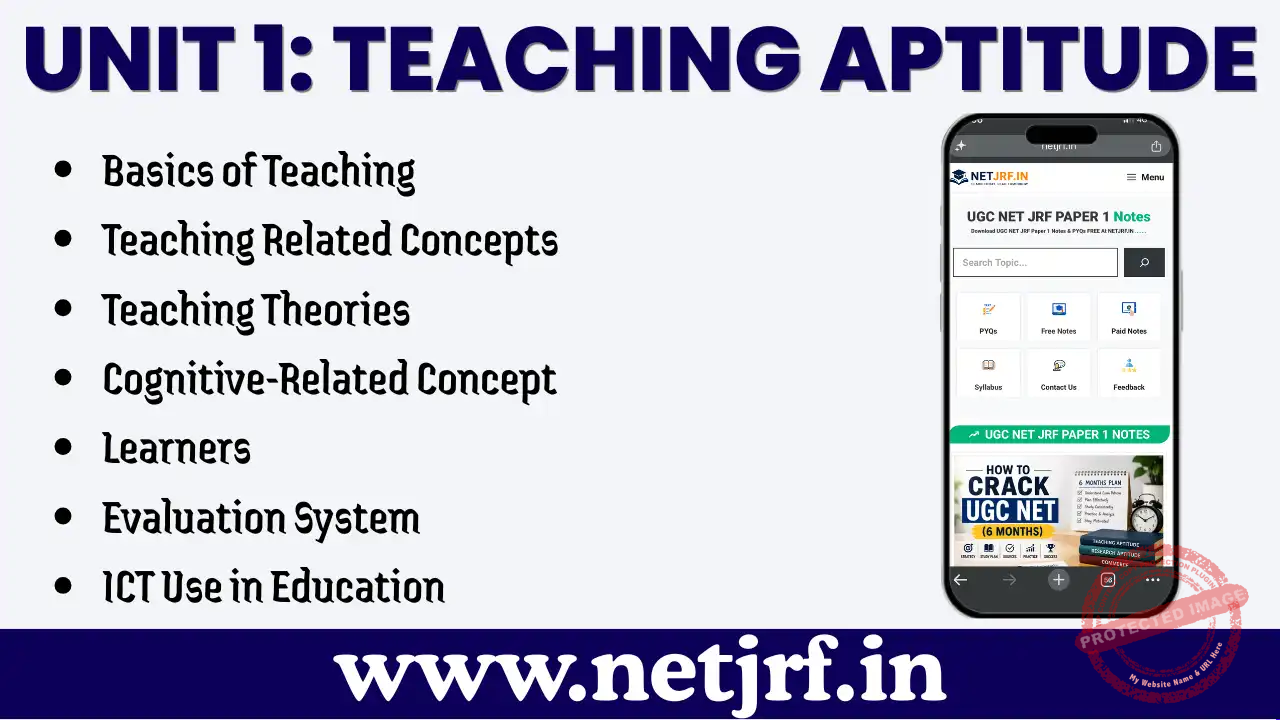
Teaching Aptitude Notes: Download complete Teaching Aptitude Notes in english and hindi for free of cost. In these notes you get the latest syllabus’s notes for UGC NET Paper 1 like Basics, Teaching Concepts, Theories, Cognition, Learners, Evaluation and ICT in Education.
Unit 1: Teaching Aptitude Notes | UGC NET Paper 1 Notes
Complete bilingual notes covering all 7 topic areas of Teaching Aptitude — Basics, Teaching Concepts, Theories, Cognition, Learners, Evaluation and ICT in Education.
Basics
Teaching Aptitude Basics
Teaching is the practice of transmitting skills, knowledge, and values to others.
Teaching Aptitude is the ability to teach and facilitate learning effectively.
T-L Model of Teaching: The T-L model of teaching is a depiction of the teaching and learning environment, including the behavior of teachers and students while the lesson is presented. Teaching is “triadic” in nature i.e. it involves 3 core elements which are — 1. Teacher 2. Student 3. Subject matter.
Some Important Points to note that: Teaching and learning are integrally related acts. Teaching is a Social Act while Learning is a Personal Act. Teaching cannot take place without learners while a learner can learn even without a teacher.
शिक्षण दूसरों तक कौशल, ज्ञान और मूल्यों को प्रसारित करने का अभ्यास है।
शिक्षण योग्यता प्रभावी ढंग से सिखाने और सीखने की सुविधा प्रदान करने की क्षमता है।
शिक्षण का टी-एल मॉडल: शिक्षण और सीखने के माहौल का चित्रण है, जिसमें पाठ प्रस्तुत करते समय शिक्षकों और छात्रों का व्यवहार भी शामिल है। शिक्षण प्रकृति में “त्रिकोणीय” है अर्थात इसमें 3 मूल तत्व शामिल हैं — 1. अध्यापक 2. विद्यार्थी 3. विषयवस्तु।
ध्यान देने योग्य कुछ महत्वपूर्ण बातें: शिक्षण और सीखना अभिन्न रूप से संबंधित कार्य हैं। शिक्षण एक सामाजिक कार्य है जबकि सीखना एक व्यक्तिगत कार्य है। शिक्षार्थियों के बिना शिक्षण नहीं हो सकता जबकि एक शिक्षार्थी शिक्षक के बिना भी सीख सकता है।
Teaching Competencies
Competency is more than just knowledge and skills. It involves the ability to meet complex demands by drawing on and mobilizing psychosocial resources (including skills and attitudes) in a particular context.
Personality and attitude Competencies — Locus of Control and Self-Efficacy, Logical, Clear, Confident and Enthusiastic.
Behavioral or Work-Related Competencies — Planning and Teaching, Managing (Organizing), Monitoring, and Communicating, Evaluating (Controlling) and Providing Feedback.
Phases of Teaching: Teaching is completed in three phases. Pre-Active Phase — planning stage of teaching before entering the classroom. Interactive Phase — the actual stage of teaching, where the teacher gives feedback and motivates students. Post-Active Phase — after completion of the class the teacher evaluates the learner’s performance.
Substantive Competencies — Subject Knowledge, Literacy Levels.
Style Related Competencies — Dynamism and flexibility, Organized and Orderly.
Social Competencies — Empathy, Social Skills.
Personal Competencies — Self-awareness, Self-Regulation, Motivation.
योग्यता सिर्फ ज्ञान और कौशल से कहीं अधिक है। इसमें किसी विशेष संदर्भ में मनोसामाजिक संसाधनों (कौशल और दृष्टिकोण सहित) को जुटाकर जटिल मांगों को पूरा करने की क्षमता शामिल है।
व्यक्तित्व एवं दृष्टिकोण संबंधी योग्यताएँ — नियंत्रण और आत्म-प्रभावकारिता का स्थान, तार्किक, स्पष्ट, आत्मविश्वासी और उत्साही।
व्यवहार या कार्य-संबंधी योग्यताएँ — योजना एवं शिक्षण, प्रबंधन (संगठन), निगरानी और संचार करना, मूल्यांकन करना (नियंत्रण करना) और फीडबैक देना।
शिक्षण के चरण: शिक्षण तीन चरणों में पूरा किया जाता है। प्री-एक्टिव चरण — कक्षा में प्रवेश करने से पहले शिक्षण की योजना बनाने का चरण। इंटरएक्टिव चरण — यह शिक्षण का वास्तविक चरण है, जहां शिक्षक प्रतिक्रिया देते हैं और छात्रों को प्रेरित करते हैं। पोस्ट-सक्रिय चरण — कक्षा के पूरा होने के बाद शिक्षक शिक्षार्थी के प्रदर्शन का मूल्यांकन करता है।
सारभूत योग्यताएँ — विषय ज्ञान, साक्षरता स्तर।
शैली संबंधी योग्यताएँ — गतिशीलता और लचीलापन, व्यवस्थित एवं सुव्यवस्थित।
सामाजिक योग्यताएँ — समानुभूति, सामाजिक कौशल।
व्यक्तिगत योग्यताएँ — आत्म जागरूकता, स्व नियमन, प्रेरणा।
Effective Teaching Behavior
Effective teaching is the knowledge, strategies, processes, and behaviors that lead to good student outcomes.
Effective Teaching Behaviors: There are two types of behaviors that lead to Effective Teaching — 1. Key Behavior 2. Helping Behavior.
5 Key Behaviours of Effective Teaching
Lesson clarity: The lesson should be conveyed in a clear step-by-step order, they should be uncomplicated and with minimal distractions.
Instructional variety: Use of a variety of teaching tools (technology, materials, activities etc). Use of variation in voice and gestures.
Teacher task orientation: To maximize the time spent teaching prevent distracting behavior, organize lessons well.
Engagement in the learning process: Keep a daily schedule to minimize confusion among students and give independent work that is interesting.
Student success rate: For a better success rate, the content should reflect prior learning, with easy-to-grasp steps for the new material.
5 Helpful Behaviours
Using student ideas and contributions: Teachers should acknowledge student responses.
Structuring: Teachers should give organized lessons of what is to come and summarize what has been taught.
Questioning: Use a variety of questions that require more thinking and problem-solving.
Probing: Getting students to elaborate on their ideas.
Teacher affects: Develop the teacher-learner relationship by the use of enthusiasm and empathy.
Cognitive Apprenticeship: A cognitive apprenticeship focuses on bringing internal thought processes into the open so they can be observed and learned by students. It is a relationship in which an expert stretches and supports a novice’s understanding of and use of cultural skills. The theory is broken into six teaching methods.
Scaffolding: Scaffolding is an instructional practice where a teacher gradually removes guidance and support as students learn and become more competent. It is a technique to provide the right kind of support in the right amount at the right time to increase a child’s competence.
प्रभावी शिक्षण वह ज्ञान, रणनीतियाँ, प्रक्रियाएँ और व्यवहार हैं जो छात्रों को अच्छे परिणाम प्रदान करते हैं।
प्रभावी शिक्षण व्यवहार: दो प्रकार के व्यवहार हैं जो प्रभावी शिक्षण की ओर ले जाते हैं — 1. मुख्य व्यवहार 2. मददगार व्यवहार।
प्रभावी शिक्षण के 5 मुख्य व्यवहार
पाठ को स्पष्ट: चरण-दर-चरण क्रम में संप्रेषित किया जाना चाहिए, वे सरल और न्यूनतम विकर्षण वाले होने चाहिए।
विभिन्न प्रकार के शिक्षण उपकरणों का उपयोग (प्रौद्योगिकी, सामग्री, गतिविधियाँ, आदि)। आवाज और हावभाव में भिन्नता का प्रयोग।
शिक्षक कार्य अभिविन्यास: शिक्षण में बिताए गए समय को अधिकतम करने के लिए ध्यान भटकाने वाले व्यवहार को रोकें, पाठों को अच्छी तरह से व्यवस्थित करें।
सीखने की प्रक्रिया में संलग्नता: छात्रों के बीच भ्रम को कम करने और स्वतंत्र कार्य को दिलचस्प बनाने के लिए एक दैनिक कार्यक्रम रखें।
छात्र सफलता दर: बेहतर सफलता दर के लिए, सामग्री को नई सामग्री के लिए आसानी से समझ में आने वाले चरणों के साथ पूर्व शिक्षा को प्रतिबिंबित करना चाहिए।
5 मददगार व्यवहार
छात्रों के विचारों और योगदानों का उपयोग करना: शिक्षकों को छात्रों की प्रतिक्रियाओं को स्वीकार करना चाहिए।
संरचना: शिक्षकों को आने वाले समय का व्यवस्थित पाठ देना चाहिए और जो पढ़ाया गया है उसका सारांश प्रस्तुत करना चाहिए।
प्रश्न पूछना: विभिन्न प्रकार के प्रश्नों का उपयोग करें जिनके लिए अधिक सोच-विचार और समस्या-समाधान की आवश्यकता होती है।
जांच करना: छात्रों को अपने विचारों को विस्तार से बताना।
शिक्षक प्रभाव: उत्साह और सहानुभूति के उपयोग से शिक्षक-शिक्षार्थी संबंध विकसित करें।
संज्ञानात्मक शिक्षुता: आंतरिक विचार प्रक्रियाओं को खुले में लाने पर केंद्रित है ताकि उन्हें छात्रों द्वारा देखा और सीखा जा सके। यह एक ऐसा रिश्ता है जिसमें एक विशेषज्ञ एक नौसिखिया की सांस्कृतिक कौशल की समझ और उसके उपयोग का विस्तार और समर्थन करता है, सिद्धांत को छह शिक्षण विधियों में विभाजित किया गया है।
मचान: मचान एक अनुदेशात्मक अभ्यास है जहां एक शिक्षक धीरे-धीरे मार्गदर्शन और समर्थन को हटा देता है क्योंकि छात्र सीखते हैं और अधिक सक्षम हो जाते हैं। यह बच्चे की क्षमता बढ़ाने के लिए सही समय पर सही मात्रा में सही प्रकार की सहायता प्रदान करने की एक तकनीक है।
Teaching Aids or Support System
A teaching support system is a combination of tools and resources that help teachers improve the effectiveness of the teaching-learning process. The goal of a teaching support system is to maximize student achievement. It has two types — traditional and modern.
Traditional TSS (Teacher-centered) — A teacher-directed method, the chalk-and-talk method, a whiteboard.
Modern TSS (Learner-centered) — Brainstorming, group discussion, study through ICT etc.
Mind/Concept Map: A mind map is a visual diagram that organizes information into a hierarchy. It’s often created around a single concept, with associated representations of ideas such as images, words, and parts of words added.
Brainstorming: A group problem-solving technique that involves generating new ideas and solutions. It can be done individually or in a group.
Think-Pair-Share: A cooperative learning activity in which the instructors pose a question, and students first think to themselves and discuss their response with a person sitting near them.
Fishbowl Technique: Students are separated into an inner and outer circle. In the inner circle, students have a discussion; students in the outer circle listen to the discussion and take notes. Good for developing listening as well as speaking skills.
Buzz Group Method: Small groups of 2-3 participants discuss a specific question. Since the small groups produce a buzzing sound while discussing, this method is known as a buzz group.
Gamification: Transforming the classroom environment and regular activities into a game. It requires creativity, collaboration, and play.
Flipped Classroom: Structured around the idea that lecture or direct instruction is not the best use of class time. Students encounter information before class, freeing class time for higher-order thinking activities.
The Jigsaw strategy: Asks a group of students to share specific knowledge with another group of students, helping them understand and retain information while developing collaboration skills.
Cybernetics: Means to navigate the system to the desired goal through feedback. In the classroom, teaching-learning is a system and the goal is the success of the learner and the learning process.
शिक्षण सहायता प्रणाली उपकरण और संसाधनों का एक संयोजन है जो शिक्षकों को शिक्षण-सीखने की प्रक्रिया की प्रभावशीलता में सुधार करने में मदद करती है। इसका लक्ष्य छात्र उपलब्धि को अधिकतम करना है। इसके दो प्रकार हैं — पारंपरिक और आधुनिक।
पारंपरिक टीएसएस (शिक्षक-केंद्रित) — एक शिक्षक निर्देशित विधि, चाक-चौबंद विधि, व्हाईट बोर्ड।
आधुनिक टीएसएस (शिक्षार्थी-केंद्रित) — विचार-मंथन, सामूहिक चर्चा, आईसीटी आदि के माध्यम से पढ़ाई।
मन/अवधारणा मानचित्र: माइंड मैप एक दृश्य आरेख है जो जानकारी को एक पदानुक्रम में व्यवस्थित करता है। यह अक्सर एक ही अवधारणा के आसपास बनाया जाता है, जिसमें छवियों, शब्दों और शब्दों के कुछ हिस्सों जैसे विचारों के संबंधित प्रतिनिधित्व जोड़े जाते हैं।
विचार-मंथन: एक समूह समस्या-समाधान तकनीक है जिसमें नए विचार और समाधान उत्पन्न करना शामिल है। इसे व्यक्तिगत रूप से या समूह में किया जा सकता है।
थिंक-पेयर-शेयर: एक सहकारी शिक्षण गतिविधि है जिसमें प्रशिक्षक एक प्रश्न पूछते हैं, और छात्र पहले खुद सोचते हैं और अपने पास बैठे व्यक्ति के साथ अपनी प्रतिक्रिया पर चर्चा करते हैं।
फिशबाउल चर्चा: छात्रों को एक आंतरिक और बाहरी सर्कल में विभाजित किया जाता है। आंतरिक घेरे में छात्र चर्चा करते हैं; बाहरी घेरे में छात्र चर्चा सुनते हैं और नोट्स लेते हैं। यह तकनीक सुनने के साथ-साथ बोलने के अच्छे कौशल विकसित करने के लिए अच्छी है।
बज़ समूह विधि: 2-3 प्रतिभागियों के छोटे समूह एक विशिष्ट प्रश्न पर चर्चा करते हैं। चूँकि छोटे समूह चर्चा करते समय गुंजन ध्वनि उत्पन्न करते हैं, इस पद्धति को गुंजन समूह के रूप में जाना जाता है।
गेमिफिकेशन: कक्षा के माहौल और नियमित गतिविधियों को एक खेल में बदलने के बारे में है। इसमें रचनात्मकता, सहयोग और खेल की आवश्यकता होती है।
फ़्लिप्ड कक्षा: इस विचार के इर्द-गिर्द संरचित है कि व्याख्यान या प्रत्यक्ष निर्देश कक्षा के समय का सबसे अच्छा उपयोग नहीं है। छात्रों को कक्षा से पहले जानकारी मिलती है, जिससे कक्षा का समय उच्च-क्रम की सोच वाली गतिविधियों के लिए खाली हो जाता है।
जिग्सॉ रणनीति: छात्रों के एक समूह को छात्रों के दूसरे समूह के साथ एक विशिष्ट ज्ञान साझा करने के लिए कहती है। यह छात्रों को सहयोग कौशल विकसित करने के साथ-साथ जानकारी को समझने और बनाए रखने में मदद करती है।
साइबरनेटिक्स: फीडबैक के माध्यम से सिस्टम को वांछित लक्ष्य तक पहुंचाना है। कक्षा में शिक्षण-सीखने की प्रक्रिया एक प्रणाली है और लक्ष्य शिक्षार्थी और सीखने की प्रक्रिया की सफलता है।
Teaching-related Concepts
Levels of Teaching
The level of teaching generally comprises three levels: Memory level (Thoughtless teaching), Understanding level (Thoughtful teaching), Reflective level (Upper thoughtful level).
1. Memory level of teaching: It is the first and thoughtless level of teaching, considered the lowest level of teaching. At this level, the focus is on drills and remembering and recalling facts and information.
2. Understanding level of teaching: Understanding something is to perceive or comprehend the meaning. At this level, students are taught with positive and negative examples. The teacher tries to clarify the relationship between facts and concepts. Students are encouraged to elaborate their answers in their own words.
3. Reflective level of teaching: The term ‘reflective level’ is indicative of the highest level of thoughtfulness on the part of the teacher as well as the learner. At this level, cognitive and critical thinking is encouraged and teaching is done through problem-solving and discussions.
शिक्षण के स्तर में आम तौर पर तीन स्तर शामिल होते हैं: स्मृति स्तर (विचारहीन शिक्षण), समझ का स्तर (विचारशील शिक्षण), चिंतनशील स्तर (ऊपरी विचारशील स्तर)।
1. शिक्षण का स्मृति स्तर: यह शिक्षण का प्रथम एवं विचारहीन स्तर है। इसे शिक्षण का निम्नतम स्तर माना जाता है। इस स्तर पर, ध्यान अभ्यास और तथ्यों और सूचनाओं को याद रखने पर है।
2. शिक्षण का समझ स्तर: किसी चीज़ को समझना उसके अर्थ को समझना है। इस स्तर पर छात्रों को सकारात्मक और नकारात्मक उदाहरणों के साथ पढ़ाया जाता है। शिक्षक तथ्यों और अवधारणाओं के बीच संबंध को स्पष्ट करने का प्रयास करता है। विद्यार्थियों को अपने उत्तरों को अपने शब्दों में विस्तृत करने के लिए प्रोत्साहित किया जाता है।
3. शिक्षण का चिंतनशील स्तर: ‘चिंतनशील स्तर’ शब्द शिक्षक के साथ-साथ शिक्षार्थी की ओर से उच्चतम स्तर की विचारशीलता का सूचक है। इस स्तर पर, संज्ञानात्मक और आलोचनात्मक सोच को प्रोत्साहित किया जाता है और शिक्षण समस्या-समाधान और चर्चाओं के माध्यम से किया जाता है।
Modalities of Teaching
Teaching: Seeks to impart knowledge and aims to develop critical and creative thinking in the learner.
Training: Intended to develop abilities through disciplined drills or a patterned behavior conducted by the teacher to promote organized ideas.
Conditioning: Associative presentation of ideas from teacher to students that are similar or dissimilar, resulting in change in behavior through habit formation by reinforcement.
Instruction: Provides step-by-step directions so another can complete a task. It also has an active interchange (give and take) of ideas between teacher and students.
Indoctrination: One-way imposition of ideas from the teacher to the students leads to establishing beliefs and values which eventually leads to a change in attitude.
शिक्षण: इसका उद्देश्य ज्ञान प्रदान करना है और शिक्षार्थी में आलोचनात्मक और रचनात्मक सोच विकसित करना है।
प्रशिक्षण: इसका उद्देश्य संगठित विचारों को बढ़ावा देने के लिए शिक्षक द्वारा अनुशासित अभ्यास या पैटर्न वाले व्यवहार के माध्यम से क्षमताओं को विकसित करना है।
कंडीशनिंग: शिक्षक से छात्रों के बीच समान या असमान विचारों की सहयोगी प्रस्तुति जिसके परिणामस्वरूप सुदृढीकरण द्वारा आदत निर्माण के माध्यम से व्यवहार में परिवर्तन होता है।
अनुदेश: निर्देश चरण-दर-चरण निर्देश प्रदान करता है ताकि दूसरा व्यक्ति किसी कार्य को पूरा कर सके। इसमें शिक्षक और छात्रों के बीच विचारों का सक्रिय आदान-प्रदान भी होता है।
भावना (Indoctrination): शिक्षक द्वारा छात्रों पर विचारों को एकतरफा थोपने से विश्वास और मूल्य स्थापित होते हैं जिससे अंततः दृष्टिकोण में बदलाव आता है।
Models of Teaching
Models of teaching are really models of learning designed to help students acquire knowledge, information, ideas, skills, values, and ways of thinking. It is a description of the learning environment including teaching behavior.
Pedagogy, Andragogy and Heutagogy are often presented as a continuum. As the learner matures, they transition from pedagogy to andragogy, and finally to heutagogy.
Pedagogy (Children’s Learning): The learner is dependent while the teacher takes the entire responsibility to lead the learning. Hence, it is a teacher-centered approach.
Andragogy (Adult’s Learning): The learner has more independence while the teacher acts as a facilitator or guide. Hence, it is a student-centered approach.
Heutagogy (Self-directed Learning): The learner is motivated to satisfy the need for competence while the instructor only sets outcomes and provides guidance and formative feedback.
शिक्षण के मॉडल वास्तव में सीखने के मॉडल हैं जो छात्रों को ज्ञान, सूचना, विचार, कौशल, मूल्य और सोचने के तरीके हासिल करने में मदद करने के लिए डिज़ाइन किए गए हैं। यह शिक्षण व्यवहार सहित सीखने के माहौल का विवरण है।
शिक्षाशास्त्र, एंड्रागॉजी और ह्यूटागॉजी को अक्सर एक सातत्य के रूप में प्रस्तुत किया जाता है। जैसे-जैसे शिक्षार्थी परिपक्व होता है, वे शिक्षाशास्त्र से एंड्रैगोजी और अंत में ह्यूटागोजी में परिवर्तित हो जाते हैं।
शिक्षाशास्त्र (Pedagogy — बच्चों का सीखना): सीखने वाला निर्भर होता है जबकि शिक्षक सीखने का नेतृत्व करने की पूरी जिम्मेदारी लेता है। इसलिए, यह एक शिक्षक-केंद्रित दृष्टिकोण है।
एंड्रागोजी (Andragogy — वयस्कों का सीखना): शिक्षार्थी को अधिक स्वतंत्रता होती है जबकि शिक्षक एक सुविधाकर्ता या मार्गदर्शक के रूप में कार्य करता है। इसलिए, यह एक छात्र-केंद्रित दृष्टिकोण है।
ह्यूटागोजी (Heutagogy — स्व-निर्देशित सीखना): शिक्षार्थी सक्षमता की आवश्यकता को पूरा करने के लिए स्व-प्रेरित होता है जबकि प्रशिक्षक केवल परिणाम निर्धारित करता है और मार्गदर्शन तथा रचनात्मक प्रतिक्रिया प्रदान करता है।
Methods of Teaching
Teaching methods are the principles, pedagogy, and management strategies used to instruct students in a classroom. They help students understand and remember what they’ve learned. There are two types of methods of teaching.
Teacher-centered Method: The teacher is the sole leader, presenting information to the students, who have limited responsibilities and are expected to passively receive the knowledge being presented.
Lecture Method — The teacher communicates their knowledge in the form of a presentation, like a university lecture, while the students take notes.
Chalk and talk — Teaching by traditional methods focusing on the blackboard and presentation by the teacher, as opposed to more informal or interactive methods.
Demonstration — Teaching method used to communicate an idea with the aid of visuals such as flip charts, posters, PowerPoint, etc.
Team teaching, also known as collaborative teaching or co-teaching, is an instructional strategy where teachers work together regularly.
Learner-centered (Inclusive/Group) Method: Views learners as active agents. Students are encouraged to collaborate and share their unique experiences and perspectives according to their interests. Teachers work as facilitators of learning and recognize that all learners are unique. It has several types:
Active learning, in which students solve problems, answer questions, formulate questions of their own, discuss, explain, debate, or brainstorm during class.
Cooperative learning, in which students work in teams on problems and projects under conditions that assure both positive interdependence and individual accountability.
Inductive teaching and learning, in which students are first presented with challenges. Includes a heuristic method, inquiry-based learning, case-based instruction, problem-based learning, project-based learning, discovery learning, activity-based scaffolding, and just-in-time teaching.
Authoritative Teaching Style (Balanced, Structured but Supportive): The teacher is firm but fair and maintains high expectations in a supportive environment. Outcome: Students become responsible, self-motivated, and confident.
Authoritarian Teaching Style (Strict, Controlling, Teacher-Centered): The teacher is highly controlling and enforces strict discipline. Outcome: Students become obedient but may lack creativity and critical thinking.
Laissez-Faire Teaching Style (Minimal Control, Passive Students): The teacher takes a hands-off approach with little structure or direction. Outcome: Students become passive, unmotivated, or even disruptive due to lack of guidance.
Democratic Teaching Style (Participation, Cooperative Learning): The teacher balances structure and student input, encouraging active participation. Outcome: Students become engaged, independent thinkers, and cooperative learners.
शिक्षण विधियाँ वे सिद्धांत, शिक्षाशास्त्र और प्रबंधन रणनीतियाँ हैं जिनका उपयोग कक्षा में छात्रों को निर्देश देने के लिए किया जाता है। वे विद्यार्थियों को जो कुछ उन्होंने सीखा है उसे समझने और याद रखने में मदद करते हैं। शिक्षण की विधियाँ दो प्रकार की होती हैं।
शिक्षक केन्द्रित विधि: शिक्षक ही एकमात्र नेता होता है, जो छात्रों को जानकारी प्रस्तुत करता है, जिनकी जिम्मेदारियाँ सीमित होती हैं और उनसे प्रस्तुत किए जा रहे ज्ञान को निष्क्रिय रूप से प्राप्त करने की अपेक्षा की जाती है।
व्याख्यान विधि — शिक्षक अपने ज्ञान को विश्वविद्यालय व्याख्यान की तरह एक प्रस्तुति के रूप में संप्रेषित करते हैं, जबकि छात्र नोट्स लेते हैं।
चाक और बातचीत — अधिक अनौपचारिक या इंटरैक्टिव तरीकों के विपरीत, शिक्षक द्वारा ब्लैकबोर्ड और प्रस्तुति पर ध्यान केंद्रित करते हुए पारंपरिक तरीकों से शिक्षण।
प्रदर्शन — फ्लिप चार्ट, पोस्टर, पावरपॉइंट इत्यादि जैसे दृश्यों की सहायता से किसी विचार को संप्रेषित करने के लिए शिक्षण पद्धति का उपयोग किया जाता है।
टीम शिक्षण जिसे सहयोगात्मक शिक्षण या सह-शिक्षण के रूप में भी जाना जाता है, एक निर्देशात्मक रणनीति है जहां शिक्षक नियमित रूप से एक साथ काम करते हैं।
शिक्षार्थी-केन्द्रित (समावेशी/समूह) विधि: शिक्षार्थियों को सक्रिय एजेंटों के रूप में देखता है। छात्रों को उनकी रुचि के अनुसार सहयोग करने और अपने अनूठे अनुभव और दृष्टिकोण साझा करने के लिए प्रोत्साहित किया जाता है। इसके कई प्रकार हैं:
सक्रिय शिक्षण, जिसमें छात्र कक्षा के दौरान समस्याओं को हल करते हैं, प्रश्नों का उत्तर देते हैं, चर्चा करते हैं, समझाते हैं, बहस करते हैं या विचार-मंथन करते हैं।
सहकारी शिक्षा, जिसमें छात्र ऐसी परिस्थितियों में समस्याओं और परियोजनाओं पर टीमों में काम करते हैं जो सकारात्मक परस्पर निर्भरता और व्यक्तिगत जवाबदेही दोनों को सुनिश्चित करते हैं।
आगमनात्मक शिक्षण और सीखना, जिसमें छात्रों को सबसे पहले चुनौतियाँ प्रस्तुत की जाती हैं। इसमें अनुमानी विधि, पूछताछ-आधारित शिक्षा, केस-आधारित निर्देश, समस्या-आधारित शिक्षा, परियोजना-आधारित शिक्षा, खोज शिक्षा, गतिविधि-आधारित मचान और उचित समय पर शिक्षण शामिल हैं।
आधिकारिक शिक्षण शैली (संतुलित, संरचित लेकिन सहायक): शिक्षक दृढ़ लेकिन निष्पक्ष होता है और सहायक वातावरण में उच्च अपेक्षाएँ रखता है। परिणाम: छात्र जिम्मेदार, आत्म-प्रेरित और आत्मविश्वासी बनते हैं।
अधिनायकवादी शिक्षण शैली (सख्त, नियंत्रित, शिक्षक-केंद्रित): शिक्षक अत्यधिक नियंत्रित होता है और सख्त अनुशासन लागू करता है। परिणाम: छात्र आज्ञाकारी बन जाते हैं लेकिन उनमें रचनात्मकता और आलोचनात्मक सोच की कमी हो सकती है।
लेसेज-फेयर शिक्षण शैली (न्यूनतम नियंत्रण, निष्क्रिय छात्र): शिक्षक कम संरचना या दिशा के साथ हाथ-दूर दृष्टिकोण अपनाता है। परिणाम: मार्गदर्शन की कमी के कारण छात्र निष्क्रिय, अप्रेरित या यहाँ तक कि विघटनकारी हो जाते हैं।
लोकतांत्रिक शिक्षण शैली (भागीदारी, सहकारी शिक्षण): शिक्षक संरचना और छात्र इनपुट को संतुलित करता है, सक्रिय भागीदारी को प्रोत्साहित करता है। परिणाम: छात्र व्यस्त, स्वतंत्र विचारक और सहकारी शिक्षार्थी बनते हैं।
Direct and Indirect Teaching
Direct vs. Indirect Teaching is basically teacher-centered vs. student-centered learning in action.
Direct Teaching Methods (Explicit Instruction): The teacher leads the learning in a clear, structured, step-by-step way. Information is taught directly, not discovered. It is dialogic — lectures, demonstrations, drill & practice, tutorials, group discussions, Q&A sessions, offering practice and feedback.
Teacher’s role — Leader, explainer, content expert. Student’s role — Listener → guided practice → independent practice.
Best for — Teaching new concepts, basic skills (math procedures, grammar rules, lab techniques), beginners who need structure.
Strengths — Efficient, clear expectations, good for large groups. Weaknesses — Can feel passive, less critical thinking, too much reliance on teacher.
Example — A math teacher shows how to solve quadratic equations step-by-step, then students solve similar problems.
Indirect Teaching Methods (Inquiry-Based Learning): Students learn by exploring, questioning, and discovering ideas and build concepts themselves with the help of their own experiences. It is simulation and role-playing based — case studies, problem-based learning, research projects, Socratic (inquiry-based) questioning.
Teacher’s role — Facilitator, guide, question-asker. Student’s role — Active thinker, problem-solver, collaborator.
Best for — Developing critical thinking, real-world problem solving, higher-level understanding, older or more advanced learners.
Strengths — Deep understanding, encourages independence, improves communication skills. Weaknesses — Takes more time, not ideal for total beginners.
Example — Instead of explaining climate change directly, students analyze data, discuss causes, and propose solutions.
यह असल में टीचर-सेंटर्ड बनाम स्टूडेंट-सेंटर्ड लर्निंग का प्रैक्टिकल रूप है।
डायरेक्ट टीचिंग तरीके (एक्सप्लिसिट इंस्ट्रक्शन): टीचर सीखने की प्रक्रिया को साफ़, व्यवस्थित, स्टेप-बाय-स्टेप तरीके से आगे बढ़ाता है। जानकारी सीधे सिखाई जाती है, खोजी नहीं जाती। यह बातचीत वाला होता है — लेक्चर, डेमोंस्ट्रेशन, ड्रिल और प्रैक्टिस, ट्यूटोरियल, ग्रुप डिस्कशन, सवाल-जवाब सेशन।
टीचर की भूमिका — लीडर, समझाने वाला, कंटेंट एक्सपर्ट। स्टूडेंट की भूमिका — सुनने वाला → गाइडेड प्रैक्टिस → इंडिपेंडेंट प्रैक्टिस।
यह इसके लिए उपयुक्त है — नए कॉन्सेप्ट सिखाना, बेसिक स्किल्स (गणित के तरीके, ग्रामर के नियम, लैब टेक्नीक), शुरुआती लोग जिन्हें स्ट्रक्चर की ज़रूरत होती है।
फायदे — कुशल, साफ़ उम्मीदें, बड़े ग्रुप के लिए अच्छा। कमज़ोरियाँ — पैसिव महसूस हो सकता है, कम क्रिटिकल थिंकिंग, टीचर पर बहुत ज़्यादा निर्भरता।
उदाहरण — एक गणित का टीचर दिखाता है कि क्वाड्रेटिक इक्वेशन को स्टेप-बाय-स्टेप कैसे हल करें, फिर स्टूडेंट वैसे ही सवाल हल करते हैं।
अप्रत्यक्ष शिक्षण के तरीके (जांच-आधारित सीखना): छात्र विचारों को एक्सप्लोर करके, सवाल पूछकर और खोजकर सीखते हैं। यह सिमुलेशन और रोल-प्लेइंग पर आधारित है — केस स्टडी, प्रॉब्लम-बेस्ड लर्निंग, रिसर्च प्रोजेक्ट, सॉक्रेटिक (जांच-आधारित) सवाल।
शिक्षक की भूमिका — फैसिलिटेटर, गाइड, सवाल पूछने वाला। छात्र की भूमिका — एक्टिव सोचने वाला, प्रॉब्लम सॉल्व करने वाला, सहयोगी।
यह इसके लिए उपयुक्त है — क्रिटिकल थिंकिंग डेवलप करना, असल दुनिया की प्रॉब्लम सॉल्व करना, उच्च-स्तरीय समझ, बड़े या ज़्यादा एडवांस्ड सीखने वाले।
फायदे — गहरी समझ, आज़ादी को बढ़ावा देता है, कम्युनिकेशन स्किल्स में सुधार करता है। कमज़ोरियाँ — ज़्यादा समय लगता है, बिल्कुल नए सीखने वालों के लिए सही नहीं है।
उदाहरण — क्लाइमेट चेंज को सीधे समझाने के बजाय, स्टूडेंट्स डेटा का एनालिसिस करते हैं, कारणों पर चर्चा करते हैं, और समाधान बताते हैं।
Teaching Theories
Blooms Taxonomy – Domains of Learning
Bloom’s Taxonomy: In 1956, Benjamin Bloom with collaborators published a framework for categorizing educational goals which comprised three learning domains: cognitive, affective, and psychomotor, and assigned to each of these domains a hierarchy that corresponds to different levels of learning.
Bloom’s Taxonomy Revised: In 2001, one of Bloom’s original collaborators and co-editor published a revision to the 1956 hierarchy. This new revised version introduced a key change to the cognitive domain of Bloom’s Taxonomy.
ब्लूम वर्गीकरण: 1956 में, बेंजामिन ब्लूम ने सहयोगियों के साथ शैक्षिक लक्ष्यों को वर्गीकृत करने के लिए एक रूपरेखा प्रकाशित की जिसमें तीन शिक्षण डोमेन शामिल थे: संज्ञानात्मक, भावनात्मक और मनोदैहिक, और इनमें से प्रत्येक डोमेन को एक पदानुक्रम सौंपा गया जो सीखने के विभिन्न स्तरों से मेल खाता है।
ब्लूम की वर्गीकरण संशोधित: 2001 में, ब्लूम के मूल सहयोगियों और सह-संपादक में से एक ने 1956 के पदानुक्रम में एक संशोधन प्रकाशित किया। इस नए संशोधित संस्करण ने ब्लूम के वर्गीकरण के संज्ञानात्मक क्षेत्र में एक महत्वपूर्ण परिवर्तन पेश किया।
Cognitive Development Theory
Jean Piaget was a Swiss psychologist who contributed significantly to the understanding of children’s cognitive development.
Cognitive Development Theory: Piaget argued that children’s cognitive development occurs in stages.
The sensorimotor stage (0–2 Years) is the first phase of children’s cognitive development. During this stage, children primarily learn about their environment through their reflexes, senses, and motor activities.
At the age of two, children enter the preoperational stage (2–7 Years), where their ability to use mental representations, develop language, and begin to use symbols to represent objects.
The next phase is the concrete operational stage (7–11 Years), which begins around the age of seven. During this stage, children are more capable of thinking logically about concrete problems.
At the age of 11, children enter the formal operational stage (11 Years and Later). Abstract thought characterizes this stage. Children can think about abstract concepts and can think hypothetically and deductively.
जीन पियागेट एक स्विस मनोवैज्ञानिक थे जिन्होंने बच्चों के संज्ञानात्मक विकास को समझने में महत्वपूर्ण योगदान दिया।
संज्ञानात्मक विकास सिद्धांत: पियागेट ने तर्क दिया कि बच्चों का संज्ञानात्मक विकास चरणों में होता है।
सेंसरिमोटर चरण (0-2 वर्ष) बच्चों के संज्ञानात्मक विकास का पहला चरण है। इस चरण के दौरान, बच्चे मुख्य रूप से अपनी सजगता, इंद्रियों और मोटर गतिविधियों के माध्यम से अपने पर्यावरण के बारे में सीखते हैं।
दो साल की उम्र में, बच्चे प्रीऑपरेशनल चरण (2-7 वर्ष) में प्रवेश करते हैं, जहां उनकी मानसिक प्रतिनिधित्व का उपयोग करने, भाषा विकसित करने और वस्तुओं का प्रतिनिधित्व करने के लिए प्रतीकों का उपयोग करने की क्षमता विकसित होती है।
अगला चरण ठोस परिचालन चरण (7-11 वर्ष) है, जो सात साल की उम्र के आसपास शुरू होता है। इस चरण के दौरान, बच्चे ठोस समस्याओं के बारे में तार्किक रूप से सोचने में अधिक सक्षम होते हैं।
11 वर्ष की आयु में, बच्चे औपचारिक परिचालन चरण (11 वर्ष और बाद) में प्रवेश करते हैं। अमूर्त विचार इस चरण की विशेषता है। बच्चे अमूर्त अवधारणाओं के बारे में सोच सकते हैं और काल्पनिक और निगमनात्मक ढंग से सोच सकते हैं।
Vygotskys Theories
Lev Vygotsky: L. S. Vygotsky was a Russian psychologist.
Social constructivism Theory: Based on the idea that learners construct new knowledge. The constructivist method is composed of at least five stages: inviting ideas, exploration, proposition, explanation and solution, and taking action.
Zone of Proximal Development (ZPD): Emphasizes that learning occurs through social interaction and collaboration. It is defined as the space between what a learner can do without assistance and what a learner can do with adult guidance or in collaboration with more capable peers.
लेव वायगोत्स्की: एल. एस. वायगोत्स्की एक रूसी मनोवैज्ञानिक थे।
सामाजिक रचनावाद सिद्धांत: इस विचार पर आधारित है कि शिक्षार्थी नए ज्ञान का निर्माण करते हैं। रचनावादी पद्धति कम से कम पाँच चरणों से बनी है: विचारों को आमंत्रित करना, अन्वेषण, प्रस्ताव, स्पष्टीकरण और समाधान, और कार्रवाई करना।
निकटवर्ती विकास का क्षेत्र (ZPD): समीपस्थ विकास क्षेत्र इस बात पर जोर देता है कि सीखना सामाजिक संपर्क और सहयोग के माध्यम से होता है। इसे एक शिक्षार्थी बिना सहायता के क्या कर सकता है और एक शिक्षार्थी वयस्क मार्गदर्शन या अधिक सक्षम साथियों के सहयोग से क्या कर सकता है, के बीच के स्थान के रूप में परिभाषित किया गया है।
Behaviorism
Ivan Pavlov’s Classical Conditioning: Pavlov identified a fundamental associative learning process called classical conditioning. Classical conditioning refers to learning that occurs when a neutral (conditioned) stimulus becomes associated with a stimulus (unconditioned) that naturally produces a behavior.
BF Skinner’s Operant Conditioning: A method of learning the uses of rewards and punishment (reinforcements) to modify behavior. Through operant conditioning, behavior that is rewarded is likely to be repeated, and behavior that is punished will rarely occur.
इवान पावलोव की शास्त्रीय कंडीशनिंग: पावलोव ने शास्त्रीय कंडीशनिंग नामक एक मौलिक सहयोगी सीखने की प्रक्रिया की पहचान की। यह उस सीखने से है जो तब होता है जब एक तटस्थ (वातानुकूलित) उत्तेजना एक उत्तेजना (बिना शर्त) के साथ जुड़ जाती है जो स्वाभाविक रूप से एक व्यवहार उत्पन्न करती है।
बीएफ स्किनर की संचालक कंडीशनिंग: यह व्यवहार को संशोधित करने के लिए पुरस्कार और दंड (सुदृढीकरण) के उपयोग को सीखने की एक विधि है। ऑपरेटिव कंडीशनिंग के माध्यम से, जिस व्यवहार को पुरस्कृत किया जाता है, उसके दोहराए जाने की संभावना होती है, और जिस व्यवहार को दंडित किया जाता है, वह शायद ही कभी घटित होता है।
Cooperative Learning Theory
Cooperative learning is the instructional use of small groups through which students work together to maximize their own and each other’s learning. It is related to collaborative learning, which emphasizes that learning occurs as an effect of community.
Key elements of Cooperative Learning Theory: Positive interdependence, individual and group accountability, interpersonal and small group skills, face-to-face promotive interaction, group processing.
Jigsaw Method 🧩 — Each student in a group is assigned a different piece of the topic to research. They become the “expert” on their part and then teach it to their group.
Think-Pair-Share 💬 — Students think about a question individually, pair up and discuss their thoughts, then share their answers with the whole class.
Team-Pair-Solo 🎯 — Students first work on a problem as a team, then in pairs, and finally individually. Helps transition from group work to independent learning.
Peer Teaching (Expert Groups) 🎓 — Each student masters a part of the lesson, then teaches their section to their classmates.
Round Robin 🔄 — Students take turns contributing ideas in a group, going around in a circle. Encourages equal participation and brainstorming.
Fishbowl Discussion 🐟 — A small group of students discusses a topic in an inner circle (the “fishbowl”), while the rest observe and take notes.
Numbered Heads Together 🧠 — Each student in a team gets a number. The teacher asks a question, the group discusses, and the teacher randomly calls a number to answer.
Rally Coach 👥 — Students work in pairs to solve problems. One solves while the other coaches and checks, then they switch roles.
Talking Chips 🎟️💬 — Students use chips to take turns speaking, encouraging equal participation in group discussions.
सहकारी शिक्षा छोटे समूहों का अनुदेशात्मक उपयोग है जिसके माध्यम से छात्र अपनी और एक-दूसरे की शिक्षा को अधिकतम करने के लिए मिलकर काम करते हैं। यह सहयोगात्मक शिक्षण से संबंधित है, जो इस बात पर जोर देता है कि सीखना समुदाय के प्रभाव के रूप में होता है।
सहकारी शिक्षण सिद्धांत के प्रमुख तत्व: सकारात्मक परस्पर निर्भरता, व्यक्तिगत एवं समूह जवाबदेही, पारस्परिक और छोटे समूह कौशल, आमने-सामने प्रचारात्मक बातचीत, समूह प्रसंस्करण।
जिग्सॉ विधि 🧩 — समूह में प्रत्येक छात्र को शोध के लिए विषय का एक अलग हिस्सा सौंपा जाता है। वे अपनी ओर से “विशेषज्ञ” बन जाते हैं और फिर इसे अपने समूह को पढ़ाते हैं।
सोचें-जोड़ी-साझा करें 💬 — छात्र व्यक्तिगत रूप से एक प्रश्न के बारे में सोचते हैं, जोड़ी बनाते हैं और अपने विचारों पर चर्चा करते हैं, फिर पूरी कक्षा के साथ साझा करते हैं।
टीम-जोड़ी-एकल 🎯 — छात्र पहले एक टीम के रूप में, फिर जोड़े में और अंत में व्यक्तिगत रूप से किसी समस्या पर काम करते हैं।
सहकर्मी शिक्षण (विशेषज्ञ समूह) 🎓 — प्रत्येक छात्र पाठ के एक भाग में महारत हासिल करता है। फिर वे अपने सहपाठियों को अपना भाग पढ़ाते हैं।
राउंड रॉबिन 🔄 — छात्र एक समूह में विचारों का योगदान देते हुए बारी-बारी से एक सर्कल में घूमते हैं। समान भागीदारी और विचार-मंथन को प्रोत्साहित करता है।
फिशबोल चर्चा 🐟 — छात्रों का एक छोटा समूह एक आंतरिक सर्कल (“फिशबोल”) में एक विषय पर चर्चा करता है, जबकि बाकी लोग निरीक्षण करते हैं और नोट्स लेते हैं।
एक साथ गिने हुए सिर 🧠 — टीम में प्रत्येक छात्र को एक नंबर मिलता है। शिक्षक एक प्रश्न पूछता है, और समूह उत्तर पर चर्चा करता है।
रैली कोच 👥 — छात्र समस्याओं को हल करने के लिए जोड़े में काम करते हैं। एक छात्र हल करता है, जबकि दूसरा कोचिंग और जाँच करता है।
टॉकिंग चिप्स 🎟️💬 — छात्र बारी-बारी से बोलने के लिए चिप्स का उपयोग करते हैं। समूह चर्चा में समान भागीदारी को प्रोत्साहित करता है।
Cognition-related Concepts
Memory and its types
Memory consists of recalling a past experience that has been retained in the mind. Memory consists of learning, retention, recall, and recognition.
Remembering — Learning consists of perceiving facts, repeating perceptions of them and forming associations in the mind.
Retention — When we learn a lesson repeatedly with attention, it leaves a subconscious trace in the mind in the form of a mental disposition.
Recall — The fact of retention can be proved by a recall. We can recall those things which we learn and have retained in the mind.
Recognition — The feeling of familiarity that accompanies the revival of past experiences.
Types of Memory: There are four types of memory — sensory, short-term, working, and long-term memories.
1. Sensory Memory: Allows you to remember sensory information after the stimulation has ended.
2. Short-term/Immediate memory: Allows you to recall specific information about anything for a brief period.
3. Working memory: A temporary holding and processing of information to accomplish complex cognitive tasks such as language comprehension, learning, and reasoning — the information you are focusing on at a given moment.
4. Long-term Memory: The unlimited storage of information for long periods, even for life. There are two types: declarative or explicit memory and non-declarative or implicit memory.
Explicit (Declarative) memory — Memories we consciously and deliberately took time to form and recall. Episodic (Incidental) Memory is formed from particular episodes in your life. Semantic Memory is general facts and bits of information you absorbed over the years.
Implicit (Non-Declarative) Memory — Unconscious memories, such as certain abilities or skills. Of four types: Procedural memory (motor and executive skills needed to perform a task), Associative memory (storage and retrieval through association with other information — Classical Conditioning Effects), Non-associative memory (newly learned behavior through repeated exposure to an isolated stimulus), Priming (exposure to one stimulus influences how someone responds to a later stimulus).
स्मृति में पिछले अनुभव को याद करना शामिल है जिसे दिमाग में रखा गया है। मेमोरी में सीखना, अवधारण, रिकॉल और पहचान शामिल है।
याद रखना — सीखने में तथ्यों को समझना और उनकी धारणा को दोहराना और मन में जुड़ाव बनाना शामिल है।
प्रतिधारण — जब हम किसी पाठ को बार-बार ध्यान से सीखते हैं, तो यह मानसिक स्वभाव के रूप में मन में एक अवचेतन निशान छोड़ जाता है।
रिकॉल — रिटेंशन के तथ्य को रिकॉल द्वारा सिद्ध किया जा सकता है। हम उन चीजों को याद कर सकते हैं जो हम सीखते हैं और दिमाग में रखते हैं।
मान्यता — अपनेपन की भावना है जो पिछले अनुभवों के पुनरुद्धार के साथ होती है।
मेमोरी के प्रकार: स्मृति चार प्रकार की होती है — संवेदी, अल्पकालिक, क्रियाशील और दीर्घकालिक स्मृतियाँ।
1. संवेदी स्मृति: यह आपको उत्तेजना समाप्त होने के बाद संवेदी जानकारी याद रखने की अनुमति देता है।
2. अल्पकालिक/तत्काल स्मृति: यह आपको किसी भी चीज़ के बारे में विशिष्ट जानकारी को थोड़े समय के लिए याद रखने की अनुमति देता है।
3. क्रियाशील स्मृति: यह भाषा की समझ जैसे जटिल संज्ञानात्मक कार्यों को पूरा करने के लिए जानकारी का अस्थायी भंडारण और प्रसंस्करण है — वह जानकारी जिस पर आप किसी निश्चित समय पर ध्यान केंद्रित कर रहे हैं।
4. दीर्घकालीन स्मृति: लंबी अवधि के लिए, यहां तक कि जीवन भर के लिए जानकारी का असीमित भंडारण है। इसके दो प्रकार हैं: घोषणात्मक या स्पष्ट स्मृति और गैर-घोषणात्मक या अंतर्निहित स्मृति।
स्पष्ट स्मृति — जिन स्मृतियों को हमने जानबूझकर बनाने और याद करने में समय लिया। एपिसोडिक (प्रासंगिक) मेमोरी आपके जीवन के विशेष प्रसंगों से बनती है। सिमेंटिक मेमोरी सामान्य तथ्य और जानकारी के टुकड़े हैं जिन्हें आपने वर्षों में अवशोषित किया है।
अंतर्निहित स्मृति — अचेतन स्मृतियाँ, जैसे कुछ योग्यताएँ या कौशल। चार प्रकार की: प्रक्रियात्मक मेमोरी (कार्य करने हेतु आवश्यक मोटर व कार्यकारी कौशल याद रखना), साहचर्य स्मृति (अन्य सूचनाओं के साथ जुड़कर भंडारण और पुनर्प्राप्ति), गैर-सहयोगी स्मृति (अलग उत्तेजना के बार-बार संपर्क से नया सीखा व्यवहार), प्राइमिंग (एक उत्तेजना का असर बाद की उत्तेजना पर प्रतिक्रिया को प्रभावित करना)।
Memory Loss and its types
Memory consists of recalling a past experience that has been retained in the mind. Memory consists of learning, retention, recall, and recognition.
Remembering — Learning consists of perceiving facts, repeating perceptions of them and forming associations in the mind.
Retention — When we learn a lesson repeatedly with attention, it leaves a subconscious trace in the mind in the form of a mental disposition.
Recall — The fact of retention can be proved by a recall. We can recall those things which we learn and have retained in the mind.
Recognition — The feeling of familiarity that accompanies the revival of past experiences.
Types of Memory: There are four types of memory — sensory, short-term, working, and long-term memories.
1. Sensory Memory: Allows you to remember sensory information after the stimulation has ended.
2. Short-term/Immediate memory: Allows you to recall specific information about anything for a brief period.
3. Working memory: A temporary holding and processing of information to accomplish complex cognitive tasks such as language comprehension, learning, and reasoning — the information you are focusing on at a given moment.
4. Long-term Memory: The unlimited storage of information for long periods, even for life. There are two types: declarative or explicit memory and non-declarative or implicit memory.
Explicit (Declarative) memory — Memories we consciously and deliberately took time to form and recall. Episodic (Incidental) Memory is formed from particular episodes in your life. Semantic Memory is general facts and bits of information you absorbed over the years.
Implicit (Non-Declarative) Memory — Unconscious memories, such as certain abilities or skills. Of four types: Procedural memory, Associative memory, Non-associative memory, Priming.
स्मृति में पिछले अनुभव को याद करना शामिल है जिसे दिमाग में रखा गया है। मेमोरी में सीखना, अवधारण, रिकॉल और पहचान शामिल है।
याद रखना — सीखने में तथ्यों को समझना और उनकी धारणा को दोहराना और मन में जुड़ाव बनाना शामिल है।
प्रतिधारण — जब हम किसी पाठ को बार-बार ध्यान से सीखते हैं, तो यह मानसिक स्वभाव के रूप में मन में एक अवचेतन निशान छोड़ जाता है।
रिकॉल — रिटेंशन के तथ्य को रिकॉल द्वारा सिद्ध किया जा सकता है। हम उन चीजों को याद कर सकते हैं जो हम सीखते हैं और दिमाग में रखते हैं।
मान्यता — अपनेपन की भावना है जो पिछले अनुभवों के पुनरुद्धार के साथ होती है।
मेमोरी के प्रकार: स्मृति चार प्रकार की होती है — संवेदी, अल्पकालिक, क्रियाशील और दीर्घकालिक स्मृतियाँ।
1. संवेदी स्मृति: यह आपको उत्तेजना समाप्त होने के बाद संवेदी जानकारी याद रखने की अनुमति देता है।
2. अल्पकालिक/तत्काल स्मृति: यह आपको किसी भी चीज़ के बारे में विशिष्ट जानकारी को थोड़े समय के लिए याद रखने की अनुमति देता है।
3. क्रियाशील स्मृति: यह जटिल संज्ञानात्मक कार्यों को पूरा करने के लिए जानकारी का अस्थायी भंडारण और प्रसंस्करण है।
4. दीर्घकालीन स्मृति: इसके दो प्रकार हैं: घोषणात्मक या स्पष्ट स्मृति और गैर-घोषणात्मक या अंतर्निहित स्मृति।
अंतर्निहित स्मृति चार प्रकार की होती है: प्रक्रियात्मक मेमोरी, साहचर्य स्मृति, गैर-सहयोगी स्मृति, प्राइमिंग।
Meta Cognition
Metacognition refers to the awareness and understanding of one’s thought processes. It involves thinking about how we think and learn and using this awareness to manage and improve our cognitive activities.
Planning (Organizing): Deciding on the strategies to use and organizing how to approach a task. Includes setting goals and deciding how to allocate resources and time.
Monitoring: Observing and assessing one’s own understanding and performance during the task, being aware of one’s cognitive processes and making adjustments as needed.
Evaluating: Reflecting on the outcome after completing the task — assessing effectiveness of strategies used, determining what worked well or poorly, and planning future improvements.
KWL Charts: A graphic organizer with three columns — What I Know, What I Want to Know, and What I Learned.
Concept (Mind) Maps: Visual diagrams that show relationships between concepts or ideas.
Self-Assessment Rubrics: Criteria-based tools where students evaluate their own work or performance against set standards.
Peer Review: Students evaluate each other’s work and provide feedback.
मेटाकॉग्निशन का तात्पर्य किसी व्यक्ति की विचार प्रक्रियाओं के बारे में जागरूकता और समझ से है। इसमें यह सोचना शामिल है कि हम कैसे सोचते हैं और सीखते हैं और इस जागरूकता का उपयोग करके अपनी संज्ञानात्मक गतिविधियों को प्रबंधित और बेहतर बनाते हैं।
योजना बनाना (संगठन): उपयोग की जाने वाली रणनीतियों पर निर्णय लेना और किसी कार्य को कैसे करना है, इसका आयोजन करना।
निगरानी: कार्य के दौरान अपनी समझ और प्रदर्शन का अवलोकन और मूल्यांकन करना।
मूल्यांकन: कार्य पूरा करने के बाद परिणाम पर विचार करना, यह निर्धारित करना कि क्या अच्छा या बुरा काम किया, और भविष्य में सुधार के लिए योजनाएँ बनाना।
KWL चार्ट: तीन स्तंभों वाला एक ग्राफ़िक आयोजक — मैं क्या जानता हूँ, मैं क्या जानना चाहता हूँ, और मैंने क्या सीखा।
अवधारणा (मन) मानचित्र: दृश्य आरेख जो अवधारणाओं या विचारों के बीच संबंध दिखाते हैं।
स्व-मूल्यांकन रूब्रिक: मानदंड-आधारित उपकरण जहाँ छात्र निर्धारित मानकों के विरुद्ध अपने स्वयं के कार्य या प्रदर्शन का मूल्यांकन करते हैं।
सहकर्मी समीक्षा: छात्र एक-दूसरे के कार्य का मूल्यांकन करते हैं और प्रतिक्रिया देते हैं।
Learners
Learning, Factors and Gender Bias
What is Learning: Learning is a continuous process through which a person acquires knowledge, skills, attitudes, and behaviors. In other words, learning is selecting the appropriate response and connecting it with the stimulus.
Important Characteristics of Learning: Continuous – Happens throughout life. Progressive – Develops step by step over time. Goal-oriented – Usually directed toward improvement or solving problems. Based on experience and practice – Learning grows through interaction with the environment. Results in change in behaviour – This change can be in thinking, emotions, or actions.
Learning Progression Steps: Learning develops in stages from basic understanding to creativity.
Recall of facts and information — Remembering learned material such as definitions, dates, formulas, or concepts. The foundation of learning.
Explain ideas or concepts — Understanding and describing information in one’s own words. Shows comprehension.
Use information in new situations — Applying knowledge to solve problems or handle unfamiliar tasks.
Draw connections — Relating ideas, comparing concepts, identifying patterns and relationships. Encourages deeper thinking.
Produce new work — Creating original ideas, projects, or solutions using learned knowledge. The highest level of learning.
Factors Influencing Learning: Learning is affected by several internal and external conditions.
1. Socio-economic and Historio-cultural Factors — Family income, education level, and resources. Cultural values, traditions, and social expectations. Language background and social environment.
2. Heredity — Inherited traits such as intelligence level, physical abilities, and temperament.
3. Mental Health — Emotional stability, stress levels, anxiety, or depression affect concentration and memory.
4. Attention — Ability to focus is essential for understanding and retaining information.
5. Readiness — Learning occurs best when the learner is physically, mentally, and emotionally prepared.
6. Fatigue — Physical or mental tiredness reduces concentration, memory, and performance.
Gender Bias: Refers to unequal treatment or expectations based on gender. Stereotypes like “boys are better at math” or “girls are better at languages.”
Effects: Limits confidence and participation. Affects subject choice and career paths. Can reduce academic performance due to low self-belief.
How to Reduce Gender Bias: Use gender-neutral language. Encourage equal participation. Provide equal opportunities in all subjects. Challenge stereotypes in teaching materials.
अधिगम क्या है: अधिगम एक निरंतर प्रक्रिया है, जिसके माध्यम से व्यक्ति ज्ञान, कौशल, दृष्टिकोण तथा व्यवहार अर्जित करता है। दूसरे शब्दों में, अधिगम उपयुक्त प्रतिक्रिया का चयन करना और उसे उद्दीपन के साथ जोड़ना है।
अधिगम की महत्वपूर्ण विशेषताएँ: निरंतर – यह पूरे जीवन भर चलता रहता है। प्रगतिशील – यह समय के साथ चरणबद्ध रूप से विकसित होता है। लक्ष्य-उन्मुख – सामान्यतः यह सुधार या समस्याओं के समाधान की दिशा में निर्देशित होता है। अनुभव और अभ्यास पर आधारित – अधिगम पर्यावरण के साथ अंतःक्रिया से विकसित होता है। व्यवहार में परिवर्तन का परिणाम – यह परिवर्तन सोच, भावनाओं या क्रियाओं में हो सकता है।
अधिगम की प्रगति के चरण: अधिगम क्रमिक चरणों में विकसित होता है, जहाँ मूल समझ से रचनात्मकता तक की यात्रा होती है।
1. तथ्यों एवं सूचनाओं का स्मरण — परिभाषाएँ, तिथियाँ, सूत्र या अवधारणाएँ जैसे सीखे गए विषयों को याद रखना। यह अधिगम की आधारशिला है।
2. विचारों या अवधारणाओं की व्याख्या करना — सूचना को अपने शब्दों में समझाना और वर्णन करना। यह समझ को दर्शाता है।
3. नई परिस्थितियों में जानकारी का उपयोग — प्राप्त ज्ञान का उपयोग समस्याओं के समाधान या अपरिचित कार्यों को करने में करना।
4. संबंध स्थापित करना — विचारों को जोड़ना, अवधारणाओं की तुलना करना, पैटर्न और संबंधों की पहचान करना। यह गहन चिंतन को प्रोत्साहित करता है।
5. नवीन कार्य का सृजन — सीखे गए ज्ञान का उपयोग कर मौलिक विचार, परियोजनाएँ या समाधान तैयार करना। यह अधिगम का सर्वोच्च स्तर माना जाता है।
अधिगम को प्रभावित करने वाले कारक: अधिगम अनेक आंतरिक तथा बाह्य परिस्थितियों से प्रभावित होता है।
1. सामाजिक-आर्थिक एवं ऐतिहासिक-सांस्कृतिक कारक — परिवार की आय, शिक्षा का स्तर तथा उपलब्ध संसाधन। सांस्कृतिक मूल्य, परंपराएँ और सामाजिक अपेक्षाएँ। भाषाई पृष्ठभूमि और सामाजिक वातावरण।
2. वंशानुक्रम — बुद्धि-स्तर, शारीरिक क्षमताएँ तथा स्वभाव जैसे गुण जन्मजात होते हैं।
3. मानसिक स्वास्थ्य — भावनात्मक स्थिरता, तनाव का स्तर, चिंता या अवसाद एकाग्रता और स्मरण शक्ति को प्रभावित करते हैं।
4. ध्यान — केंद्रित रहने की क्षमता समझने और जानकारी को स्मरण रखने के लिए अत्यंत आवश्यक है।
5. तत्परता — जब शिक्षार्थी शारीरिक, मानसिक और भावनात्मक रूप से तैयार होता है, तब अधिगम सर्वाधिक प्रभावी होता है।
6. थकान — शारीरिक या मानसिक थकावट एकाग्रता, स्मृति और कार्य-निष्पादन को कम कर देती है।
लैंगिक पक्षपात: लिंग के आधार पर असमान व्यवहार या अपेक्षाओं से है। जैसे रूढ़ धारणाएँ — “लड़के गणित में बेहतर होते हैं” या “लड़कियाँ भाषाओं में अच्छी होती हैं।”
प्रभाव: आत्मविश्वास और सहभागिता को सीमित करता है। विषय चयन और करियर के मार्ग को प्रभावित करता है। कम आत्मविश्वास के कारण शैक्षणिक प्रदर्शन में गिरावट आ सकती है।
लैंगिक पक्षपात को कम करने के उपाय: लैंगिक-तटस्थ भाषा का प्रयोग करना। सभी को समान भागीदारी के लिए प्रोत्साहित करना। सभी विषयों में समान अवसर प्रदान करना। शिक्षण सामग्री में मौजूद रूढ़ धारणाओं को चुनौती देना।
Types of Learners and Learning
A learner is someone who is willing to learn and understand new things. Learning is the process of understanding and acquiring knowledge of new things and concepts.
Individual Differences in Learners: It is important for teachers to know variables such as physical characteristics, intelligence, perception, gender, ability, and learning styles.
Conventional learning (Passive Learning): Involves a mentor or teacher, a confined facility, and a group of students that meet together at a fixed time. Follows the trend of testing knowledge through exams.
Situated learning: A theory that explains how people acquire professional skills. Involves students in cooperative activities that challenge their critical thinking and kinesthetic abilities.
Assisted Learning: A learning process based on both individual study of educational materials and guidance on the subject matter by the tutor/trainer.
Collaborative Learning (Active Learning): Involves pupils working together on activities or learning tasks in a group small enough to ensure that everyone participates.
Latent Learning: A type of learning that is not immediately apparent. It occurs without obvious reinforcement of the behavior or associations learned — it remains hidden until there is a need to use it.
Adolescent vs Adult Learners: Adolescent learners bring enthusiasm, curiosity, and energy, while adults bring life experience and their own ideas and opinions.
Field-Dependent and Field-Independent Learners: Field-dependent people are better at learning social material in a social way. Field-independent people are less reliant on structure and more self-motivated.
Learning curve: A graph that shows how quickly someone learns something over time, and how much progress is being made.
Learning Plateau: A term for physical, mental, attitude, and emotional exhaustion of an individual due to intensive involvement in work for a long period of time.
Learning to Learn: Focused on the skills, knowledge, and attitudes associated with the learning process and how individuals learn best.
Learner Behavior: Entering Behavior — describes the student level before instruction begins. Terminal Behavior — the desired final behavior shaped by a training or learning process.
Personal vs social competence: Personal Competence — Self-Awareness, Empathy, Self-Regulation, Motivation. Social Competence — Empathy, Social Skills.
शिक्षार्थी वह व्यक्ति होता है जो नई चीजें सीखने और समझने का इच्छुक होता है। सीखना नई चीज़ों और अवधारणाओं को समझने और ज्ञान प्राप्त करने की प्रक्रिया है।
शिक्षार्थियों में व्यक्तिगत अंतर: शिक्षकों के लिए शारीरिक विशेषताओं, बुद्धि, धारणा, लिंग, क्षमता और सीखने की शैली जैसे चर को जानना महत्वपूर्ण है।
पारंपरिक शिक्षा (निष्क्रिय शिक्षा): इसमें एक संरक्षक या शिक्षक, एक सीमित सुविधा और छात्रों का एक समूह शामिल होता है जो एक निश्चित समय पर एक साथ मिलते हैं।
सिचुएटेड लर्निंग: एक सिद्धांत है जो बताता है कि लोग पेशेवर कौशल कैसे हासिल करते हैं। इसमें छात्रों को सहकारी गतिविधियों में शामिल किया जाता है।
सहायता प्राप्त शिक्षा: शैक्षिक सामग्री के व्यक्तिगत अध्ययन और शिक्षक/प्रशिक्षक द्वारा विषय वस्तु पर मार्गदर्शन दोनों पर आधारित एक सीखने की प्रक्रिया।
सहयोगात्मक शिक्षा (सक्रिय शिक्षा): विद्यार्थियों को एक छोटे समूह में गतिविधियों या सीखने के कार्यों पर एक साथ काम करना शामिल होता है।
अव्यक्त अधिगम: एक प्रकार का अधिगम है जो तुरंत स्पष्ट नहीं होता है। यह तब तक छिपा रहता है जब तक उसका उपयोग करने की आवश्यकता न हो।
किशोर बनाम वयस्क शिक्षार्थी: किशोर शिक्षार्थी उत्साह, जिज्ञासा और ऊर्जा लाते हैं, जबकि वयस्क जीवन का अनुभव लाते हैं।
क्षेत्र-निर्भर और क्षेत्र-स्वतंत्र शिक्षार्थी: क्षेत्र-निर्भर लोग सामाजिक सामग्री सामाजिक तरीके से सीखने में बेहतर होते हैं। क्षेत्र-स्वतंत्र लोग संरचना पर कम निर्भर और अधिक आत्म-प्रेरित होते हैं।
सीखने की अवस्था (Learning Curve): एक ग्राफ है जो दर्शाता है कि कोई व्यक्ति समय के साथ कितनी जल्दी कुछ सीखता है।
लर्निंग प्लेटो: लंबे समय तक काम में गहन भागीदारी के कारण किसी व्यक्ति की शारीरिक, मानसिक और भावनात्मक थकावट को सीखने का पठार कहा जाता है।
लर्निंग टू लर्न: यह सीखने की प्रक्रिया से जुड़े कौशल, ज्ञान और दृष्टिकोण पर केंद्रित है।
शिक्षार्थी का व्यवहार: व्यवहार में प्रवेश — निर्देश शुरू होने से पहले छात्र के स्तर का वर्णन करता है। टर्मिनल व्यवहार — वांछित अंतिम व्यवहार जो प्रशिक्षण या सीखने की प्रक्रिया द्वारा आकार दिया जाता है।
व्यक्तिगत बनाम सामाजिक क्षमता: व्यक्तिगत योग्यता — आत्म-जागरूकता, समानुभूति, स्व-नियमन, प्रेरणा। सामाजिक क्षमता — समानुभूति, सामाजिक कौशल।
SRL and Transfer of Learning
Self-regulated learning (SRL): A broad concept involving students using a set of skills to manage their learning environment and process. SRL is guided by metacognition, strategic action, and motivation to learn.
Cycle of SRL — Analyzing the task: Identify the skills and knowledge you need to learn. Setting Goal: Set goals for what you want to learn. Devising plans: Include specific steps, resources, and time frame. Enacting tactics and strategies: Breaking tasks into smaller steps, using mnemonics, practicing regularly. Regulating learning: Monitoring progress, adjusting the plan, and staying motivated.
Transfer of Learning: Refers to the application of knowledge, skills, or abilities learned in one context to a different but related context.
Positive Transfer: Learning in one situation enhances performance in another. Example: Learning sitar can positively affect learning guitar.
Negative Transfer: Learning in one context hinders performance in another due to confusion. Example: Someone used to driving on the left struggles driving on the right.
Zero transfer: Learning in one context has no effect on performance in a different context.
Near Transfer: Applying learned skills to a situation very similar to the original context. Example: Using school math skills for budgeting or shopping.
Far Transfer: Applying skills to a situation quite different from the original context. Example: Applying physics problem-solving to business strategy.
High-road transfer involves deliberate, conscious application of skills to new situations, requiring effortful reflective thinking.
Low-road transfer refers to automatic, often unconscious application of well-practiced skills to familiar situations.
स्व-विनियमित शिक्षण (एसआरएल): एक व्यापक अवधारणा है जिसमें छात्रों को अपने सीखने के माहौल और सीखने की प्रक्रिया को प्रबंधित करने के लिए कौशल के एक सेट का उपयोग करना शामिल है।
एस.आर.एल. का चक्र — कार्य का विश्लेषण करना: कौशलों और ज्ञान की पहचान करना। लक्ष्य निर्धारित करना: सीखने के लक्ष्य तय करना। योजनाएँ बनाना: विशिष्ट कदम, संसाधन और समय सीमा शामिल करना। रणनीति बनाना: कार्य को छोटे चरणों में बाँटना, स्मरणीय उपकरण उपयोग करना। सीखने को विनियमित करना: प्रगति की निगरानी और समायोजन करना।
सीखने का हस्तांतरण: एक संदर्भ में सीखे गए ज्ञान, कौशल या क्षमताओं को दूसरे लेकिन संबंधित संदर्भ में लागू करने को संदर्भित करता है।
सकारात्मक हस्तांतरण: एक परिस्थिति में सीखने से दूसरी परिस्थिति में प्रदर्शन में सुधार होता है। उदाहरण: सितार बजाना सीखना गिटार सीखने में मदद कर सकता है।
नकारात्मक हस्तांतरण: एक संदर्भ में सीखने से दूसरे में प्रदर्शन में बाधा आती है। उदाहरण: बाईं ओर गाड़ी चलाने का आदी व्यक्ति दाईं ओर गाड़ी चलाते समय संघर्ष कर सकता है।
शून्य हस्तांतरण: एक संदर्भ में सीखने का किसी दूसरे संदर्भ में प्रदर्शन पर कोई प्रभाव नहीं पड़ता।
निकट स्थानांतरण: सीखे गए कौशल को मूल संदर्भ से मिलती-जुलती स्थिति में लागू करना। उदाहरण: स्कूल के गणित कौशल का उपयोग बजट बनाने में करना।
दूर स्थानांतरण: कौशल को मूल संदर्भ से काफी अलग स्थिति में लागू करना। उदाहरण: भौतिक विज्ञान की रणनीतियों को व्यावसायिक संदर्भ में लागू करना।
हाई-रोड ट्रांसफर में सीखे गए कौशल को नई स्थितियों में जानबूझकर और सचेत रूप से लागू करना शामिल है।
लो-रोड ट्रांसफर में सीखे गए कौशल को परिचित स्थितियों में स्वचालित और अचेतन रूप से लागू करना शामिल है।
Learners Characteristics
Academic Characteristics: Describe a learner’s performance in school tasks, including achievement level, study habits, participation, and motivation.
Social Characteristics: Relate to how learners interact with peers and adults, including communication skills, cooperation, and relationship-building.
Emotional Characteristics: Involve feelings, self-confidence, emotional control, and resilience.
Cognitive Characteristics: Concern thinking abilities such as memory, attention, reasoning, and problem-solving.
Physical Characteristics: Include health, energy levels, sensory abilities, and physical development.
Behavioral Characteristics: Observable actions such as self-discipline, responsibility, and ability to follow rules.
Cultural Characteristics: Stem from a learner’s language, beliefs, values, and family background.
Technological Characteristics: Refer to access to digital tools and the ability to use technology effectively.
Personality Characteristics: Include traits like introversion or extroversion, curiosity, persistence, and independence.
शैक्षणिक विशेषताएँ: शिक्षार्थी के विद्यालयीय कार्यों में प्रदर्शन को दर्शाती हैं, जिनमें उपलब्धि स्तर, अध्ययन आदतें, सहभागिता तथा सीखने की प्रेरणा शामिल है।
सामाजिक विशेषताएँ: शिक्षार्थियों के सहपाठियों और वयस्कों के साथ अंतःक्रिया करने के तरीकों से संबंधित हैं।
भावनात्मक विशेषताएँ: इनमें भावनाएँ, आत्मविश्वास, भावनात्मक नियंत्रण तथा लचीलापन शामिल हैं।
संज्ञानात्मक विशेषताएँ: ये स्मृति, ध्यान, तर्कशक्ति तथा समस्या-समाधान जैसी चिंतन क्षमताओं से संबंधित हैं।
शारीरिक विशेषताएँ: इनमें स्वास्थ्य, ऊर्जा स्तर, संवेदी क्षमताएँ तथा शारीरिक विकास शामिल हैं।
व्यवहारिक विशेषताएँ: ये अनुशासन, उत्तरदायित्व तथा नियमों का पालन करने की क्षमता जैसे आचरण से संबंधित हैं।
सांस्कृतिक विशेषताएँ: ये शिक्षार्थी की भाषा, मान्यताओं, मूल्यों तथा पारिवारिक पृष्ठभूमि से उत्पन्न होती हैं।
प्रौद्योगिकीय विशेषताएँ: ये डिजिटल साधनों तक पहुँच और तकनीक का प्रभावी उपयोग करने की क्षमता को संदर्भित करती हैं।
व्यक्तित्व संबंधी विशेषताएँ: इनमें अंतर्मुखता या बहिर्मुखता, जिज्ञासा, दृढ़ता तथा स्वतंत्रता जैसे गुण शामिल हैं।
Intelligence, Creativity and Motivation
Intelligence is the ability of an individual to learn, understand, reason, solve problems, think abstractly, and adapt to new situations. Characteristics: ability to learn from experience, logical reasoning, problem-solving ability, adaptability, abstract thinking.
Factors Influencing Intelligence: 1. Heredity (Genetic Factors) — children inherit mental capacities from parents, setting the upper limit of intelligence. 2. Environment — home environment, school environment, socio-economic status, culture, nutrition and health, peer group.
Creativity is the ability to produce new, original, useful, and meaningful ideas or solutions. Mainly related to divergent thinking, where multiple solutions are possible.
Difference Between Creativity and Intelligence: Intelligence focuses on accuracy and correctness, mostly using convergent thinking aimed at one correct answer. Creativity focuses on innovation and imagination, using divergent thinking which allows many possible answers. Intelligence is measured through IQ tests; creativity through tests of fluency, flexibility, originality, and elaboration.
Motivation is the process that energizes, directs, and sustains behavior.
1. Intrinsic Motivation: Comes from within the learner — learning for interest or enjoyment, leading to deep and long-term learning. Examples: curiosity, love of learning, satisfaction.
2. Extrinsic Motivation: Comes from outside rewards — learning for marks, prizes, or praise. Examples: grades, rewards, punishment avoidance.
Self-Efficacy vs Self-Esteem: Self-efficacy is a person’s confidence in their ability to perform a specific task successfully (“I can do this”). Self-esteem refers to a person’s overall feelings of self-worth or value.
Ability and Willingness: Ability is the skill, knowledge, or capacity that enables a person to perform a task. Willingness refers to the desire, interest, or motivation to perform a task. Both are essential for effective learning.
बुद्धिमत्ता से अभिप्राय व्यक्ति की वह संज्ञानात्मक क्षमता है जिसके माध्यम से वह अधिगम करता है, समझ विकसित करता है, तर्क करता है, समस्याओं का समाधान करता है, अमूर्त रूप से चिंतन करता है तथा नवीन परिस्थितियों के अनुकूलन की क्षमता प्रदर्शित करता है।
बुद्धिमत्ता को प्रभावित करने वाले कारक: 1. वंशानुक्रम — बच्चे अपने माता-पिता से मानसिक क्षमताएँ उत्तराधिकार में प्राप्त करते हैं, जो बुद्धिमत्ता की उच्चतम सीमा निर्धारित करता है। 2. पर्यावरण — गृह-पर्यावरण, विद्यालयीन पर्यावरण, सामाजिक-आर्थिक स्थिति, संस्कृति, पोषण एवं स्वास्थ्य, सहपाठी समूह।
रचनात्मकता वह क्षमता है जिसके द्वारा व्यक्ति नवीन, मौलिक, उपयोगी तथा सार्थक विचारों या समाधानों का सृजन करता है। मुख्यतः विविधोन्मुख चिंतन से संबंधित है, जिसमें अनेक संभावित समाधान संभव होते हैं।
रचनात्मकता और बुद्धिमत्ता के बीच अंतर: बुद्धिमत्ता शुद्धता और सही उत्तर पर केंद्रित होती है, यह प्रायः अभिसारी चिंतन का उपयोग करती है। रचनात्मकता नवोन्मेष और कल्पनाशीलता पर केंद्रित होती है, यह मुख्यतः अपसारी चिंतन का उपयोग करती है। बुद्धिमत्ता का मापन IQ परीक्षणों से, रचनात्मकता का आकलन प्रवाहिता, लचीलापन, मौलिकता और विस्तार से किया जाता है।
प्रेरणा वह प्रक्रिया है जो व्यवहार को ऊर्जा प्रदान करती है, उसे दिशा देती है तथा उसे निरंतर बनाए रखती है।
1. आंतरिक प्रेरणा: सीखने वाले के भीतर से उत्पन्न होती है — रुचि या आनंद के लिए अधिगम, जो गहन एवं दीर्घकालिक अधिगम को प्रोत्साहित करती है। उदाहरण: जिज्ञासा, सीखने का प्रेम, संतुष्टि।
2. बाह्य प्रेरणा: बाहरी पुरस्कारों से उत्पन्न होती है — अंक, पुरस्कार या प्रशंसा के लिए अधिगम। उदाहरण: अंक, पुरस्कार, दंड से बचाव।
आत्म-प्रभावकारिता बनाम आत्म-सम्मान: आत्म-प्रभावकारिता किसी विशिष्ट कार्य को सफलतापूर्वक संपन्न करने की अपनी क्षमता में व्यक्ति के विश्वास से है (“मैं यह कर सकता/सकती हूँ”)। आत्म-सम्मान व्यक्ति की अपनी समग्र आत्म-मूल्य की भावना से है।
क्षमता और इच्छा: क्षमता वह कौशल या योग्यता है जो व्यक्ति को कार्य संपन्न करने में सक्षम बनाती है। इच्छा किसी कार्य को करने की अभिलाषा या प्रेरणा से है। प्रभावी अधिगम के लिए दोनों आवश्यक हैं।
Evaluation System
Summative and Formative
Formative evaluation is a type of evaluation that assesses the development or progress of a course to improve its effectiveness. It is done during the learning period to provide feedback to students as well as teachers so necessary changes can be made. For Example — Tests, Quizzes, discussions, etc.
Summative (Impact) Evaluation is a type of evaluation that occurs at the end of a learning period. It assesses students’ learning and provides a final grade for performance. More reliable than formative evaluations, and formal in nature. For Example — Semester exams, Board Exams, Final Grades, etc.
निर्माणात्मक मूल्यांकन एक प्रकार का मूल्यांकन है जो किसी पाठ्यक्रम की प्रभावशीलता में सुधार के लिए उसके विकास या प्रगति का आकलन करता है। यह सीखने की अवधि के दौरान छात्रों के साथ-साथ शिक्षकों को फीडबैक प्रदान करने के लिए किया जाता है। उदाहरण के लिए — परीक्षण, प्रश्नोत्तरी, चर्चाएँ, आदि।
योगात्मक (प्रभाव) मूल्यांकन सीखने की अवधि के अंत में होता है। यह छात्रों के सीखने का आकलन करता है और अंतिम ग्रेड प्रदान करता है। यह रचनात्मक मूल्यांकन की तुलना में अधिक विश्वसनीय और प्रकृति में औपचारिक है। उदाहरण के लिए — सेमेस्टर परीक्षा, बोर्ड परीक्षा, अंतिम ग्रेड, आदि।
CRT and NRT
Criterion-referenced testing (CRT): Assessments designed to measure a student’s performance against a fixed set of criteria or learning standards. The score is independent of how other students perform. Defined in Percentage.
Norm-referenced testing (NRT): Compares a student’s knowledge or skills to the knowledge or skills of the norm group, determined by comparing scores against a selected group of test-takers. Defined in Percentile.
मानदंड-संदर्भित परीक्षण (सीआरटी): ये मूल्यांकन और परीक्षण हैं जो मानदंडों या सीखने के मानकों के एक निश्चित सेट के खिलाफ छात्र के प्रदर्शन को मापने के लिए डिज़ाइन किए गए हैं। यह स्कोर इस बात से स्वतंत्र है कि अन्य छात्र कैसा प्रदर्शन कर रहे हैं। इसे प्रतिशत में परिभाषित किया गया है।
मानक-संदर्भित परीक्षण (एनआरटी): किसी छात्र के ज्ञान या कौशल की तुलना मानक समूह के ज्ञान या कौशल से करता है। इसका निर्धारण परीक्षार्थियों के चयनित समूह के प्रदर्शन परिणामों के विरुद्ध अंकों की तुलना करके किया जाता है। इसे परसेंटाइल में परिभाषित किया गया है।
Test Types
Diagnostic Test: Primarily used to diagnose students’ difficulties and to guide lesson and curriculum planning.
Prognostic Test: Acts as a means of estimation and prediction of the future career.
Aptitude Test: Designed to assess what a person is capable of doing or to predict what a person is able to learn or do given the right education and instruction.
Achievement Test: A test of developed skill or knowledge.
Authentic assessment: Where students thoughtfully apply their acquired skills in real-life situations.
Ipsative assessments: Evaluate an individual’s performance or traits in relation to their own previous performance. Focus on personal progress and growth.
Peer evaluation: An effective collaborative learning strategy that asks students to reflect on contributions made by colleagues in group work. An innovative approach to evaluation systems.
नैदानिक परीक्षण: यह मुख्य रूप से छात्रों की कठिनाइयों का निदान करने और पाठ और पाठ्यचर्या योजना का मार्गदर्शन करने के लिए उपयोग किया जाता है।
प्रोग्नॉस्टिक टेस्ट: भविष्य के करियर के अनुमान और भविष्यवाणी के साधन के रूप में कार्य करते हैं।
रुचि परीक्षा: यह आकलन करने के लिए डिज़ाइन किया गया है कि कोई व्यक्ति क्या करने में सक्षम है या सही शिक्षा और निर्देश दिए जाने पर क्या सीख सकता है।
उपलब्धि परीक्षण: विकसित कौशल या ज्ञान का परीक्षण है।
प्रामाणिक मूल्यांकन: वह है जहां छात्र सोच-समझकर अपने अर्जित कौशल को वास्तविक जीवन की स्थितियों में लागू करते हैं।
इप्सेटिव आकलन: किसी व्यक्ति के पिछले प्रदर्शन के संबंध में उसके प्रदर्शन या गुणों का मूल्यांकन करता है। व्यक्तिगत प्रगति और विकास पर ध्यान केंद्रित करते हैं।
सहकर्मी का मूल्यांकन: एक प्रभावी सहयोगी शिक्षण रणनीति है जो छात्रों को समूह कार्य में सहकर्मियों द्वारा किए गए योगदान पर विचार करने के लिए कहती है।
ICT use in Education
LMS and MOOC
LMS: A learning management system is a software application for the administration, documentation, and delivery of educational courses, training programs, materials, or learning and development programs. Common LMS platforms — MOODLE, Canvas, Schoology, Edmodo, LearnDash, OpenedX, Course Builder, etc.
MOOCs: Massive Open Online Courses (MOOCs) are free online courses available for anyone to enroll in.
एलएमएस: एक शिक्षण प्रबंधन प्रणाली शैक्षिक पाठ्यक्रमों, प्रशिक्षण कार्यक्रमों, सामग्रियों, या सीखने और विकास कार्यक्रमों के प्रशासन, दस्तावेज़ीकरण और वितरण के लिए एक सॉफ्टवेयर एप्लिकेशन है। कुछ सामान्य एलएमएस प्लेटफॉर्म — मूडल, कैनवस, स्कूलोजी, एडमोडो, लर्नडैश, ओपनएक्स, कोर्स बिल्डर, आदि।
एमओओसी: मैसिव ओपन ऑनलाइन पाठ्यक्रम (एमओओसी) किसी के भी नामांकन के लिए निःशुल्क ऑनलाइन पाठ्यक्रम उपलब्ध हैं।
SWAYAM
SWAYAM (Study Webs of Active Learning for Young Aspiring Minds): This MOOC platform was initiated by the Government of India and developed indigenously by AICTE in 2017 to achieve three cardinal principles of Education Policy — access, equity, and quality.
The courses hosted on SWAYAM are in 4 quadrants — (1) video lecture, (2) reading material, (3) self-assessment tests, (4) discussion forum for clearing doubts.
A ‘SWAYAM’ course is classified based on the engagement of the number of weeks and the number of video hours.
In 2021, the University Grants Commission (UGC) gave the nod to institutions to allow up to 40% of the total courses in a particular program in a semester to be offered via the SWAYAM platform.
National Coordinators of SWAYAM
| Coordinator | Full Form | Focus Area |
|---|---|---|
| AICTE | All India Council for Technical Education | International Courses |
| NPTEL | National Programme on Technology Enhanced Learning | Engineering Courses |
| UGC | University Grants Commission | Non-technical Courses, PG Education |
| CEC | Consortium for Educational Communication | Non-technical UG Courses |
| NCERT | National Council of Educational Research and Training | School Education (9th–12th) |
| NIOS | National Institute of Open Schooling | School Education (9th–12th) |
| IGNOU | Indira Gandhi National Open University | Out-of-School Students |
| IIMB | Indian Institute of Management Bangalore | Management Courses |
| NITTTR | National Institutes of Technical Teachers’ Training & Research | Teachers Training Courses |
| INI | Institutes of National Importance | Advance Courses |
SWAYAM (स्टडी वेब्स ऑफ एक्टिव लर्निंग फॉर यंग एस्पायरिंग माइंड्स): इस MOOC प्लेटफॉर्म की शुरुआत भारत सरकार ने की थी और इसे 2017 में AICTE द्वारा स्वदेशी रूप से विकसित किया गया था, ताकि शिक्षा नीति के तीन प्रमुख सिद्धांतों — पहुँच, समानता और गुणवत्ता — को प्राप्त किया जा सके।
SWAYAM पर होस्ट किए जाने वाले पाठ्यक्रम 4 चतुर्थांशों में हैं — (1) वीडियो व्याख्यान, (2) पठन सामग्री, (3) स्व-मूल्यांकन परीक्षण, (4) शंकाओं को दूर करने के लिए चर्चा मंच।
‘SWAYAM’ पाठ्यक्रम को सप्ताहों की संख्या और वीडियो घंटों की संख्या के आधार पर वर्गीकृत किया जाता है।
2021 में, विश्वविद्यालय अनुदान आयोग (UGC) ने संस्थानों को एक सेमेस्टर में किसी विशेष कार्यक्रम में कुल पाठ्यक्रमों के 40% तक SWAYAM प्लेटफ़ॉर्म के माध्यम से पेश करने की अनुमति दी है।
SWAYAM के National Coordinators — तालिका ऊपर English सेक्शन में देखें (स्रोत में इसका अलग हिंदी संस्करण उपलब्ध नहीं था)।
SWAYAM PRABHA (Old)
SWAYAM PRABHA is an initiative of the Ministry of Education to provide 40 (recently updated) High-Quality Educational Channels through DTH (Direct to Home) across the length and breadth of the country on a 24×7 basis using the GSAT-15 satellite.
SWAYAM PRABHA has new content every day for at least (4) hours, repeated 5 more times in a day, allowing students to choose their convenient time.
The channels are uplinked from BISAG, Gandhinagar, and maintained by INFLIBNET. The contents are provided by NPTEL, IITs, UGC, CEC and IGNOU.
Courses Provided by CEC-UGC
| # | Channel | Subject |
|---|---|---|
| 1 | VAGEESH | Language and Literature |
| 2 | SANSKRITI | History, Culture & Philosophy |
| 3 | PRABODH | Social & Behavioral Sciences |
| 4 | SAARASWAT | Education, Psychology, Home Science and related subjects |
| 5 | PRABANDHAN | Management, Library Science, Information Science, and related subjects |
| 6 | VIDHIK | Law, Legal Studies, Human Rights and related subjects |
| 7 | KAUTILYA | Economics, Commerce, and Finance |
| 8 | ARYABHATT | Physical sciences, Mathematics, Physics, Chemistry, and Related Subjects |
| 9 | SPANDAN | Life Sciences, Botany, Zoology, Bio-Science and related subjects |
| 10 | DAKSH | Applied Sciences, Allied Physical and Chemical sciences, and related subjects |
Courses provided by IGNOU (11–16): Social Sciences and Humanities · Basic and Applied Sciences · Professional Education · Open Universities and Gyandarshan · Capacity Building and Teacher Education · Skill and Vocational Education.
Courses provided by IITs (17–25): Biotechnology & Biochemical Engg, Electronics & Communication Engg, Electrical Engg, Physics (all IIT Bombay) · Textile Engg, IIT PAL (IIT Delhi) · Civil Engg (IIT Gandhinagar) · Aeronautical Engg, Humanities & Social Sciences (IIT Kanpur).
स्वयं प्रभा शिक्षा मंत्रालय की एक पहल है, जिसके तहत देश भर में 24×7 आधार पर जीसैट-15 उपग्रह का उपयोग करके डीटीएच के माध्यम से 40 (हाल ही में अपडेट किए गए) उच्च-गुणवत्ता वाले शैक्षिक चैनल उपलब्ध कराए जाएंगे।
स्वयं प्रभा में हर दिन कम से कम (4) घंटे के लिए नई सामग्री होती है, जिसे दिन में 5 बार दोहराया जाएगा, जिससे छात्र अपनी सुविधा के अनुसार समय चुन सकेंगे।
चैनल BISAG, गांधीनगर से अपलिंक किए गए हैं और INFLIBNET द्वारा बनाए रखे गए हैं। सामग्री NPTEL, IITs, UGC, CEC और IGNOU द्वारा प्रदान की जाती है।
CEC-UGC, IGNOU और IIT द्वारा दिए गए कोर्स की तालिका ऊपर English सेक्शन में देखें।
SWAYAM PRABHA (New)
Swayam Prabha is a group of 40 DTH channels devoted to telecasting high-quality educational programmes on a 24X7 basis using the GSAT-15 satellite. Every day there is new content for at least (4) hours, repeated 5 more times in a day. The channels are uplinked from BISAG-N, Gandhinagar. Content is provided by IITs, UGC, CEC, IGNOU, UoH. The INFLIBNET Centre maintains the web portal.
BISAG-N: Bhaskaracharya National Institute for Space Applications and Geo-informatics is an Autonomous Scientific Society that undertakes technology development & management, research & development, and facilitates national & international cooperation, capacity building and technology transfer in geo-spatial technology.
INFLIBNET: Information and Library Network Centre, Gandhinagar, is involved in modernizing university libraries in India using state-of-the-art technologies for optimum utilisation of information.
EMRC: Educational Multimedia Research Centre — centers established by the UGC to produce educational content using electronic media and ICT.
Swayam Prabha Channels
| Channel | Subject | Co-ordinator |
|---|---|---|
| CH-1: SANSKAR | Language and Literature; History, Culture & Philosophy | CEC New Delhi, EMRC EFLU Hyderabad |
| CH-2: SANVAHAK | Education, Home Science; Information, Communication & Management Studies | CEC New Delhi, MCRC Jamia Millia Islamia |
| CH-3: KAUTILYA | Economics, Commerce and Finance | Gujrat University, EMRC Ahmedabad |
| CH-4: ARYABHATT | Physical sciences, Mathematics, Physics, Chemistry | Calicut University, EMRC Calicut |
| CH-5: SPANDAN | Life Sciences, Botany, Zoology, Bio-Science | Kashmir University, EMRC Srinagar |
| CH-6: DAKSH | Applied Sciences, Allied Physical & Chemical sciences | Anna University, EMRC Chennai |
| CH-7: Vyas | Arts/Social Science/Management/Natural & Applied Science (4 bands) | CEC, New Delhi |
| CH-8: Aatmagyan | Social & Behavioural Sciences, Law, Legal Studies, Human Rights | INFLIBNET, Gandhinagar |
| CH-9 | Technology and Innovation | AICTE/MIC |
| CH-10 | Indian and Foreign Languages | IGNOU |
| CH-11 | Social Sciences and Humanities | IGNOU |
| CH-12 | Basic and Applied Sciences | IGNOU |
| CH-13 | Professional Education | IGNOU |
| CH-14 | Open Universities and Gyandarshan | IGNOU |
| CH-15 | Capacity Building and Teacher Education | IGNOU |
| CH-16 | Skill and Vocational Education | IGNOU |
| CH-17 | Biotechnology and Biochemical Engineering | IIT Bombay |
| CH-18 | Electronics and Communication Engineering | IIT Bombay |
| CH-19 | Electrical Engineering | IIT Bombay |
| CH-20 | Physics | IIT Bombay |
| CH-21 | Textile Engineering | IIT Delhi |
| CH-22 | IIT PAL | IIT Delhi |
| CH-23 | Civil Engineering | IIT Gandhinagar |
| CH-24 | Aeronautical Engineering | IIT Kanpur |
| CH-25 | Humanities and Social Sciences | IIT Kanpur |
| CH-26 | Management, Law, Economics; Business Analytics, Communication | IIT Kanpur |
| CH-27 | Mechanical Engineering, Engineering Design, Manufacturing | IIT Kanpur |
| CH-28 | Visual communications, Graphic design & Media technology | IIT Kanpur |
| CH-29 | Architecture and Interior Design | IIT Kharagpur |
| CH-30 | Computer Sciences Engineering / IT & Related Branches | IIT Kharagpur |
| CH-31 | Instrumentation Control, Biomedical and Engineering | IIT Madras |
| CH-32 | Bridge Courses and Impact Series | IIT Madras |
| CH-33 | Chemical Engineering, Nanotechnology, Environmental Sciences | IIT Madras |
| CH-34 | Health Sciences | IIT Madras |
| CH-35 | Metallurgical & Material Science, Mining and Ocean Engineering | IIT Madras |
| CH-36 | Skills and Logistics (IT-Enabled Sector, BFSI, Supply Chain) | IIT Madras |
| CH-37 | Chemistry, Biochemistry and Food Processing Engineering | IIT Tirupati |
| CH-38 | Mathematics | IIT Tirupati |
| CH-39 | Performing Arts: Classical Dances, Theatrical Arts & Painting | University of Hyderabad |
| CH-40 | Performing Arts: Indian Classical Music | University of Hyderabad |
स्वयं प्रभा 40 DTH चैनलों का एक ग्रुप है जो GSAT-15 सैटेलाइट का इस्तेमाल करके 24X7 आधार पर हाई-क्वालिटी एजुकेशनल प्रोग्राम टेलीकास्ट करने के लिए समर्पित है। हर दिन, कम से कम (4) घंटे का नया कंटेंट होगा जिसे दिन में 5 बार और दोहराया जाएगा। चैनलों को BISAG-N, गांधीनगर से अपलिंक किया जाता है। कंटेंट IIT, UGC, CEC, IGNOU, UoH द्वारा प्रदान किया जाता है। INFLIBNET सेंटर वेब पोर्टल को मेंटेन करता है।
बीआईएसएजी-एन: भास्कराचार्य नेशनल इंस्टीट्यूट फॉर स्पेस एप्लीकेशंस एंड जियो-इन्फॉर्मेटिक्स एक स्वायत्त वैज्ञानिक सोसायटी है जो जियो-स्पेशियल टेक्नोलॉजी के क्षेत्र में टेक्नोलॉजी डेवलपमेंट और मैनेजमेंट, रिसर्च और डेवलपमेंट, राष्ट्रीय और अंतर्राष्ट्रीय सहयोग को बढ़ावा देने, क्षमता निर्माण और टेक्नोलॉजी ट्रांसफर का काम करती है।
इंफॉर्मेशन एंड लाइब्रेरी नेटवर्क (INFLIBNET) सेंटर, गांधीनगर भारत में यूनिवर्सिटी लाइब्रेरी को आधुनिक बनाने में लगा हुआ है, ताकि जानकारी का सबसे अच्छा इस्तेमाल हो सके।
EMRC का मतलब भारत में उच्च शिक्षा के संदर्भ में एजुकेशनल मल्टीमीडिया रिसर्च सेंटर है। इन सेंटरों को यूनिवर्सिटी ग्रांट्स कमीशन (UGC) ने इलेक्ट्रॉनिक मीडिया और ICT का इस्तेमाल करके एजुकेशनल कंटेंट बनाने के लिए स्थापित किया था।
Swayam Prabha Channels (CH-1 से CH-40) की पूरी तालिका ऊपर English सेक्शन में देखें।
Websites for Teaching
LMS: MOODLE, Canvas, Schoology, Edmodo, LearnDash, OpenedX, Course Builder, Blackboard Learn, Nearpod.
Mindmapping Software and Websites: Miro, Coggle, MindMeister, X Mind, Mindomo, C Map, Popplet.
Animation Video Maker: Plotagon, Animaker, Powtoon.
Online Conferences: Big Blue Button, ZOOM, Microsoft Teams, Google Meet.
Interactive video Making: Edpuzzle (video), Canva (Pictures), Flip, Screen Casetify, Screencast-o-matic, Camtasia (Video editing).
Online bulletin board: Padlet, Wakelet.
Creating Interacting Quiz, surveys: Kahoot, Quizizz, Poll Everywhere, Google Forms, Mentimeter (Live), Hot Potato, Slido, Straw Poll, Survey Monkey.
Google Products: Google Meet, Google Docs, Google Classroom, Google Form.
Book and Library creating: Book-creator (Interactive), Koha (Library).
Virtual Class: Classcraft, Google Classroom, Edmodo (Social Networking), Labster (Lab).
Language Learning: Duolingo.
FOSSEE — Free/Libre and Open Source Software for Education.
Interactive whiteboard software: Jamboard, Stormboard, Conceptboard.
Interactive Teaching and Learning Material: Genially, Learningapps.org, Interacty, H5P, Educaplay.
Presentations: Google Slides, Prezi. Project Management: Trello. Research (Lab) Simulation: PhET, Labster. Collaboration: Google Docs, Seesaw.
एलएमएस: मूडल, कैनवस, स्कूलोजी, एडमोडो, लर्नडैश, ओपनडैक्स, कोर्स बिल्डर, ब्लैकबोर्ड लर्न, नियरपॉड।
माइंडमैपिंग सॉफ्टवेयर और वेबसाइटें: मिरो, कॉगल, माइंडमिस्टर, एक्स माइंड, मिंडोमो, सी मैप, पॉपलेट।
एनिमेशन वीडियो मेकर: प्लॉटागन, एनिमेकर, पॉवटून।
ऑनलाइन कॉन्फ्रेंस: बिग ब्लू बटन, ज़ूम, माइक्रोसॉफ्ट टीम्स, गूगल मीट।
इंटरैक्टिव वीडियो मेकिंग: एडपज़ल (वीडियो), कैनवा (चित्र), फ्लिप, स्क्रीन केसेटिफाई, स्क्रीनकास्ट-ओ-मैटिक, कैमटासिया।
ऑनलाइन बुलेटिन बोर्ड: पैडलेट, वेकलेट।
इंटरैक्टिंग क्विज़, सर्वेक्षण बनाना: काहूट, क्विज़िज़, पोल एवरीवेयर, गूगल फ़ॉर्म, मेन्टिमीटर, हॉट पोटैटो, स्लाइडो, स्टॉ पोल, सर्वे मंकी।
गूगल उत्पाद: गूगल मीट, गूगल डॉक्स, गूगल क्लासरूम, गूगल फ़ॉर्म।
पुस्तक और पुस्तकालय निर्माण: बुक-क्रिएटर, कोहा।
वर्चुअल क्लास: क्लासक्राफ्ट, गूगल क्लासरूम, एडमोडो, लैबस्टर।
भाषा सीखना: डुओलिंगो।
FOSSEE — शिक्षा के लिए मुफ़्त/मुक्त और ओपन सोर्स सॉफ़्टवेयर।
इंटरैक्टिव व्हाइटबोर्ड सॉफ़्टवेयर: जैमबोर्ड, स्टॉर्मबोर्ड, कॉन्सेप्टबोर्ड।
इंटरैक्टिव शिक्षण और अधिगम सामग्री: जेनियली, लर्निंगऐप.ऑर्ग, इंटरैक्टी, एच5पी, एजुकाप्ले।
प्रस्तुतियाँ: गूगल स्लाइड, प्रेज़ी। प्रोजेक्ट प्रबंधन: ट्रेलो। शोध सिमुलेशन: पीएचईटी, लैबस्टर। सहयोग: गूगल डॉक्स, सीसॉ।
Higher Education Technology
NPTEL — National Programme on Technology Enhanced Learning is a project of MHRD initiated by seven IITs (Bombay, Delhi, Kanpur, Kharagpur, Madras, Guwahati, Roorkee) along with IISc Bangalore in 2003, to provide technical education to anyone interested in learning.
GyanDarshan: Launched by MHRD, Information & Broadcasting, Prasar Bharti, and IGNOU jointly on 26th January 2000 as an Educational Television Channel of India, a 24-hour transmission channel covering a variety of subjects.
Gyanvani: Commenced broadcasting on FM 105.6 channel from June 2001, in association with IGNOU, New Delhi.
Gyandhara: An internet audio counseling service offered by IGNOU, allowing students to interact with teachers/experts via telephone, email, and chat.
DigiLocker: An Indian digitization online service under the Digital India initiative, aiming to strengthen ‘digital empowerment’ by providing access to authentic digital documents, deemed at par with original physical documents.
National Academic Depository (NAD): A 24/7 online storehouse of academic awards — certificates, diplomas, degrees, mark sheets, etc.
E-ShodhSindhu: Gives academic institutions affordable access to electronic resources (peer-reviewed journals, bibliographic databases), formed by merging UGC-INFONET Digital Library Consortium, NLIST, and INDEST-AICTE Consortium.
Shodhganga: A digital repository of Indian theses and dissertations submitted to universities in India.
ShodhGangotri: An initiative of UGC, MHRD, and INFLIBNET asking universities to deposit electronic versions of approved synopses submitted by PhD scholars.
Shodh Shuddhi: Gives HEIs access to plagiarism detection software (PDS), launched by the Ministry of Education in September 2019.
E-VIDWAN: A database of profiles for scientists, researchers, and faculty members at leading Indian institutions.
DIKSHA: A national digital platform for school education, providing digital textbooks, teacher training, lesson plans, assessments, and interactive learning resources.
Krishi Darshan: One of India’s longest-running TV programs, launched by Doordarshan in 1967, to educate farmers about agricultural techniques, schemes, weather, and crop patterns.
PM eVidya: A comprehensive initiative launched by the Ministry of Education in 2020 under Atma Nirbhar Bharat Abhiyan, integrating DIKSHA, TV channels for classes 1–12, radio, podcasts, and DTH, aiming for “One Nation, One Digital Platform” and “One Nation, One Channel”.
e-Gyankosh: A digital repository by IGNOU for free access to self-learning material for open and distance learning.
e-Yantra: An IIT Bombay initiative supported by the Ministry of Education, focused on robotics and embedded systems education.
e-Kalpa: A project under the National Mission on Education through ICT, developed by IIT Bombay’s Industrial Design Centre, for digital design education.
PG Pathshala: A UGC and INFLIBNET initiative providing high-quality e-content for postgraduate courses.
Academic Bank of Credit (ABC): A digital academic credit storehouse under NEP 2020, allowing students to deposit, transfer, and redeem credits for multiple entry/exit options.
FOSSEE: An IIT Bombay project promoting open-source software like Scilab, Python, and OpenFOAM in education.
IMPRINT-2: A joint initiative of the Ministry of Education and DST to fund research in technology and engineering for affordable innovation.
GIAN: A 2015 scheme bringing international faculty and experts to teach in Indian institutions, promoting academic collaboration.
NROER: A platform by NCERT and CIET providing free access to school-level learning resources like videos, interactive materials, and maps.
e-SARAS: An online self-learning and self-assessment system offering interactive content and digital resources.
e-Granthalaya: Software by NIC to automate and network libraries, creating digital libraries and e-catalogues.
Saransh: A CBSE web portal helping schools and parents analyze student performance through academic reports.
Sakshat: A one-stop education portal by the Ministry of Education, offering e-content, virtual labs, scholarships, and online resources.
एनपीटीईएल: सात भारतीय प्रौद्योगिकी संस्थानों (बॉम्बे, दिल्ली, कानपुर, खड़गपुर, मद्रास, गुवाहाटी, रुड़की) ने भारतीय विज्ञान संस्थान, बैंगलोर के साथ मिलकर 2003 में यह मानव संसाधन विकास मंत्रालय की परियोजना शुरू की।
ज्ञान दर्शन: मानव संसाधन विकास मंत्रालय, सूचना एवं प्रसारण, प्रसार भारती और इग्नू द्वारा संयुक्त रूप से 26 जनवरी 2000 को लॉन्च किया गया, 24 घंटे का शैक्षिक प्रसारण चैनल।
ज्ञानवाणी: जून 2001 से एफएम 105.6 चैनल पर इग्नू, नई दिल्ली के सहयोग से प्रसारण शुरू।
ज्ञानधारा: इग्नू द्वारा प्रदान की जाने वाली इंटरनेट ऑडियो परामर्श सेवा, छात्र शिक्षकों/विशेषज्ञों से टेलीफोन, ईमेल और चैट के माध्यम से बातचीत कर सकते हैं।
डिजिलॉकर: डिजिटल इंडिया पहल के तहत भारत सरकार की डिजिटलीकरण सेवा, जो प्रामाणिक डिजिटल दस्तावेजों तक पहुंच देकर ‘डिजिटल सशक्तिकरण’ को मजबूत करती है। इसके दस्तावेज़ मूल भौतिक दस्तावेजों के बराबर माने जाते हैं।
राष्ट्रीय शैक्षणिक डिपॉजिटरी (NAD): सभी अकादमिक पुरस्कारों — प्रमाण पत्र, डिप्लोमा, डिग्री, मार्कशीट आदि — का 24X7 ऑनलाइन स्टोर हाउस।
ई-शोध सिंधु: शैक्षणिक संस्थानों को इलेक्ट्रॉनिक संसाधनों तक सस्ती पहुँच देता है, UGC-INFONET, NLIST और INDEST-AICTE कंसोर्टियम को मिलाकर बना।
शोधगंगा: भारत के विश्वविद्यालयों में प्रस्तुत भारतीय शोध प्रबंधों का डिजिटल संग्रह।
शोध गंगोत्री: UGC, मानव संसाधन विकास मंत्रालय और INFLIBNET की पहल, PhD शोधार्थियों के अनुमोदित सारांश जमा कराने हेतु।
शोध शुद्धि: HEI को साहित्यिक चोरी पकड़ने वाला सॉफ़्टवेयर उपलब्ध कराता है, सितंबर 2019 में शिक्षा मंत्रालय द्वारा शुरू।
ई-विद्वान: भारत के प्रमुख शैक्षणिक संस्थानों के वैज्ञानिकों, शोधकर्ताओं और संकाय सदस्यों के प्रोफाइल का डेटाबेस।
दीक्षा: स्कूल शिक्षा के लिए डिजिटल पाठ्यपुस्तकें, शिक्षक प्रशिक्षण, पाठ योजनाएँ, मूल्यांकन और इंटरएक्टिव सामग्री देने वाला राष्ट्रीय डिजिटल मंच।
कृषि दर्शन: 1967 में दूरदर्शन पर शुरू भारत के सबसे लंबे समय तक चलने वाले कार्यक्रमों में से एक, किसानों को कृषि तकनीकों की जानकारी देने हेतु।
पीएम ई-विद्या: आत्मनिर्भर भारत अभियान के अंतर्गत 2020 में शुरू पहल, जिसमें दीक्षा, कक्षा 1–12 के टीवी चैनल, रेडियो, पॉडकास्ट और डीटीएच शामिल हैं, उद्देश्य — “वन नेशन, वन डिजिटल प्लेटफॉर्म” और “वन नेशन, वन चैनल”।
ई-ज्ञानकोश: इग्नू द्वारा विकसित डिजिटल भंडार, मुक्त और दूरस्थ शिक्षा के लिए स्व-अध्ययन सामग्री।
ई-यंत्र: आईआईटी बॉम्बे की पहल, रोबोटिक्स और एम्बेडेड सिस्टम्स शिक्षा पर केंद्रित।
ई-कल्प: आईआईटी बॉम्बे के इंडस्ट्रियल डिजाइन सेंटर द्वारा विकसित, डिजाइन शिक्षा हेतु डिजिटल वातावरण।
पीजी पाठशाला: यूजीसी और इन्फ्लिबनेट की पहल, स्नातकोत्तर पाठ्यक्रमों के लिए उच्च गुणवत्ता वाली ई-सामग्री।
शैक्षणिक बैंक ऑफ क्रेडिट (ABC): NEP 2020 के अंतर्गत डिजिटल क्रेडिट भंडार, क्रेडिट जमा/स्थानांतरित/उपयोग करने की सुविधा।
फॉसी (FOSSEE): आईआईटी बॉम्बे की परियोजना, स्काईलैब, पाइथन और ओपनफोम जैसे ओपन-सोर्स सॉफ्टवेयर को बढ़ावा देने हेतु।
इम्प्रिंट-2: शिक्षा मंत्रालय और डीएसटी की संयुक्त पहल, प्रौद्योगिकी अनुसंधान वित्त पोषण हेतु।
ज्ञान (GIAN): 2015 की योजना, अंतरराष्ट्रीय शिक्षकों को भारतीय संस्थानों में लाने हेतु।
एनआरओईआर: एनसीईआरटी और सीआईईटी का मंच, स्कूल-स्तरीय अध्ययन संसाधनों तक निःशुल्क पहुँच।
ई-सारस: ऑनलाइन स्व-अध्ययन और स्व-मूल्यांकन प्रणाली।
ई-ग्रंथालय: एनआईसी द्वारा विकसित सॉफ्टवेयर, पुस्तकालयों के स्वचालन और नेटवर्किंग हेतु।
सारांश: सीबीएसई का वेब पोर्टल, विद्यालयों और अभिभावकों के लिए शैक्षणिक प्रदर्शन विश्लेषण।
सक्षात: शिक्षा मंत्रालय का समग्र शिक्षा पोर्टल, ई-सामग्री, वर्चुअल लैब्स, छात्रवृत्ति और ऑनलाइन संसाधन।
| Teaching Aptitude | Click Here |
| Research Aptitude | Click Here |
| Comprehension | Click Here |
| Communication | Click Here |
| Mathematical Reasoning and Aptitude | Click Here |
| Logical Reasoning | Click Here |
| Data Interpretation | Click Here |
| Information and Communication Technology (ICT) | Click Here |
| People, Development and Environment | Click Here |
| Higher Education System | Click Here |
| UGC NET Official Website | ugcnet.nta.nic.in |
Frequently Asked Questions — Teaching Aptitude Notes
Common questions students ask while preparing Teaching Aptitude notes for UGC NET Paper 1.
What is Teaching Aptitude in UGC NET Paper 1?
Teaching Aptitude is the ability to teach and facilitate learning effectively. In UGC NET Paper 1, it forms Unit 1 and covers teaching concepts, theories, learner psychology, evaluation systems, and ICT tools used in education.
How many questions are asked from Teaching Aptitude in UGC NET Paper 1?
Teaching Aptitude usually contributes around 5 questions out of the 50 questions in UGC NET Paper 1, making it one of the higher-weightage units alongside Research Aptitude.
What topics are covered in Teaching Aptitude notes?
Teaching Aptitude notes cover 7 areas: Basics of teaching, Teaching-related concepts (levels, models, methods), Teaching theories, Cognition-related concepts, Learners, Evaluation systems, and ICT use in education.
What is the difference between teaching and training?
Teaching aims to impart knowledge and develop critical and creative thinking in the learner, while training focuses on developing specific abilities through disciplined, patterned practice.
What are the three levels of teaching?
The three levels of teaching are the Memory level (thoughtless teaching focused on drills and recall), the Understanding level (thoughtful teaching using examples), and the Reflective level (the highest level, using problem-solving and discussion).
What is Bloom’s Taxonomy?
Bloom’s Taxonomy is a 1956 framework by Benjamin Bloom that categorizes educational goals into three learning domains — cognitive, affective, and psychomotor — each with its own hierarchy of learning levels.
What is the difference between pedagogy, andragogy, and heutagogy?
Pedagogy is teacher-centered learning for children, andragogy is a more independent, student-centered approach for adults, and heutagogy is fully self-directed learning where the learner sets their own path.
What is the Zone of Proximal Development (ZPD)?
The Zone of Proximal Development, given by Vygotsky, is the gap between what a learner can do independently and what they can achieve with guidance from a teacher or a more capable peer.
What is the difference between intelligence and creativity?
Intelligence uses convergent thinking to reach one correct, logical answer, while creativity uses divergent thinking to generate many original and imaginative possibilities.
What is the difference between formative and summative evaluation?
Formative evaluation happens during the learning process to give ongoing feedback, like quizzes and discussions, while summative evaluation happens at the end to assign a final grade, like semester or board exams.
What is the difference between CRT and NRT?
Criterion-Referenced Testing (CRT) measures a student against a fixed standard and is scored in percentage, while Norm-Referenced Testing (NRT) compares a student to a peer group and is scored in percentile.
What is metacognition?
Metacognition is awareness and understanding of one’s own thought processes — essentially “thinking about thinking” — used to plan, monitor, and evaluate one’s own learning.
What is the difference between direct and indirect teaching methods?
Direct teaching is teacher-led and structured, such as lectures and demonstrations, while indirect teaching is student-led and inquiry-based, such as case studies and problem-based learning.
What is SWAYAM?
SWAYAM (Study Webs of Active Learning for Young Aspiring Minds) is a MOOC platform launched by the Government of India in 2017 and developed by AICTE, focused on access, equity, and quality in education.
What is the best way to prepare Teaching Aptitude notes for UGC NET Paper 1?
Organize notes unit-wise, use bilingual English-Hindi explanations for better recall, focus on comparison-based topics like CRT vs NRT or pedagogy vs andragogy, and revise regularly with practice questions.