Unit 3: Comprehension Notes
Complete bilingual notes for Comprehension — reading strategies, passage-based practice, and exam-focused explanations in English and Hindi.
Introductory Lessons
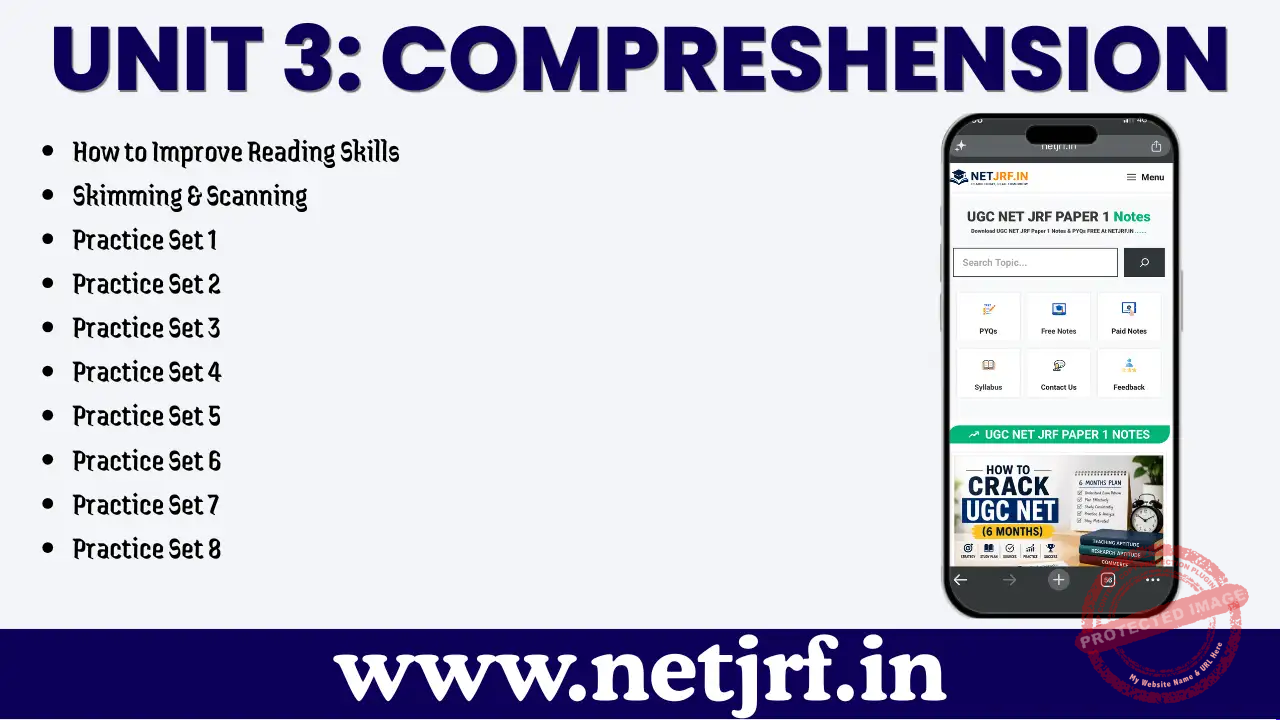
How to Improve Reading Skills
Skimming and Scanning are two reading strategies that can be useful in various situations, especially when dealing with large amounts of text or trying to quickly grasp the main ideas of a passage.
Skimming involves quickly glancing over a text to get a general sense of its content without reading every word.
Scanning involves quickly running your eyes over a text to locate specific information without reading the entire text.
Practice Passage 1 — The Industrial Revolution: The Industrial Revolution was a period of major industrialization that took place during the late 18th and early 19th centuries. It marked a significant shift from agrarian and manual labor-based economies to ones dominated by industry and machine manufacturing. Key innovations during this period included the steam engine, textile machinery, and the development of railroads. The social and economic impacts were profound, leading to urbanization, the rise of the working class, and changes in living conditions. The Industrial Revolution is often considered a turning point in human history.
Practice Passage 2 — Climate Change: Climate change is a global phenomenon characterized by long-term shifts in temperature and weather patterns. It is primarily driven by human activities, such as the burning of fossil fuels, deforestation, and industrial processes. The consequences of climate change include rising sea levels, extreme weather events, and disruptions to ecosystems. Efforts to mitigate climate change involve reducing greenhouse gas emissions, transitioning to renewable energy sources, and promoting sustainable practices.
स्किमिंग और स्कैनिंग दो पढ़ने की रणनीतियाँ हैं जो विभिन्न स्थितियों में उपयोगी हो सकती हैं, खासकर जब बड़ी मात्रा में पाठ से निपटना हो या किसी अनुच्छेद के मुख्य विचारों को जल्दी से समझने की कोशिश करना हो।
स्किमिंग में हर शब्द को पढ़े बिना किसी पाठ की सामग्री का सामान्य अर्थ प्राप्त करने के लिए उस पर तुरंत नज़र डालना शामिल है।
स्कैनिंग में संपूर्ण पाठ को पढ़े बिना विशिष्ट जानकारी का पता लगाने के लिए किसी पाठ पर तेज़ी से नज़र दौड़ाना शामिल है।
अभ्यास अनुच्छेद 1 — औद्योगिक क्रांति: औद्योगिक क्रांति प्रमुख औद्योगीकरण का काल था जो 18वीं सदी के अंत और 19वीं सदी की शुरुआत में हुआ था। इसने कृषि और शारीरिक श्रम-आधारित अर्थव्यवस्थाओं से उद्योग और मशीन विनिर्माण के प्रभुत्व वाली अर्थव्यवस्थाओं में एक महत्वपूर्ण बदलाव को चिह्नित किया। इस अवधि के दौरान प्रमुख नवाचारों में भाप इंजन, कपड़ा मशीनरी और रेलमार्गों का विकास शामिल था। सामाजिक और आर्थिक प्रभाव गहरे थे, जिससे शहरीकरण हुआ, श्रमिक वर्ग का उदय हुआ और रहने की स्थिति में बदलाव आया। औद्योगिक क्रांति को अक्सर मानव इतिहास में एक महत्वपूर्ण मोड़ माना जाता है।
अभ्यास अनुच्छेद 2 — जलवायु परिवर्तन: जलवायु परिवर्तन एक वैश्विक घटना है जो तापमान और मौसम के पैटर्न में दीर्घकालिक बदलावों की विशेषता है। यह मुख्य रूप से मानवीय गतिविधियों से प्रेरित है, जैसे जीवाश्म ईंधन जलाना, वनों की कटाई और औद्योगिक प्रक्रियाएं। जलवायु परिवर्तन के परिणामों में समुद्र के स्तर में वृद्धि, चरम मौसम की घटनाएं और पारिस्थितिक तंत्र में व्यवधान शामिल हैं। जलवायु परिवर्तन को कम करने के प्रयासों में ग्रीनहाउस गैस उत्सर्जन को कम करना, नवीकरणीय ऊर्जा स्रोतों में परिवर्तन और टिकाऊ प्रथाओं को बढ़ावा देना शामिल है।
Skimming and Scanning
Skimming and Scanning are two reading strategies that can be useful in various situations, especially when dealing with large amounts of text or trying to quickly grasp the main ideas of a passage.
Skimming involves quickly glancing over a text to get a general sense of its content without reading every word.
Scanning involves quickly running your eyes over a text to locate specific information without reading the entire text.
Practice Passage 1 — The Industrial Revolution: The Industrial Revolution was a period of major industrialization that took place during the late 18th and early 19th centuries. It marked a significant shift from agrarian and manual labor-based economies to ones dominated by industry and machine manufacturing. Key innovations during this period included the steam engine, textile machinery, and the development of railroads. The social and economic impacts were profound, leading to urbanization, the rise of the working class, and changes in living conditions. The Industrial Revolution is often considered a turning point in human history.
Practice Passage 2 — Climate Change: Climate change is a global phenomenon characterized by long-term shifts in temperature and weather patterns. It is primarily driven by human activities, such as the burning of fossil fuels, deforestation, and industrial processes. The consequences of climate change include rising sea levels, extreme weather events, and disruptions to ecosystems. Efforts to mitigate climate change involve reducing greenhouse gas emissions, transitioning to renewable energy sources, and promoting sustainable practices.
स्किमिंग और स्कैनिंग दो पढ़ने की रणनीतियाँ हैं जो विभिन्न स्थितियों में उपयोगी हो सकती हैं, खासकर जब बड़ी मात्रा में पाठ से निपटना हो या किसी अनुच्छेद के मुख्य विचारों को जल्दी से समझने की कोशिश करना हो।
स्किमिंग में हर शब्द को पढ़े बिना किसी पाठ की सामग्री का सामान्य अर्थ प्राप्त करने के लिए उस पर तुरंत नज़र डालना शामिल है।
स्कैनिंग में संपूर्ण पाठ को पढ़े बिना विशिष्ट जानकारी का पता लगाने के लिए किसी पाठ पर तेज़ी से नज़र दौड़ाना शामिल है।
अभ्यास अनुच्छेद 1 — औद्योगिक क्रांति: औद्योगिक क्रांति प्रमुख औद्योगीकरण का काल था जो 18वीं सदी के अंत और 19वीं सदी की शुरुआत में हुआ था। इसने कृषि और शारीरिक श्रम-आधारित अर्थव्यवस्थाओं से उद्योग और मशीन विनिर्माण के प्रभुत्व वाली अर्थव्यवस्थाओं में एक महत्वपूर्ण बदलाव को चिह्नित किया। इस अवधि के दौरान प्रमुख नवाचारों में भाप इंजन, कपड़ा मशीनरी और रेलमार्गों का विकास शामिल था। सामाजिक और आर्थिक प्रभाव गहरे थे, जिससे शहरीकरण हुआ, श्रमिक वर्ग का उदय हुआ और रहने की स्थिति में बदलाव आया। औद्योगिक क्रांति को अक्सर मानव इतिहास में एक महत्वपूर्ण मोड़ माना जाता है।
अभ्यास अनुच्छेद 2 — जलवायु परिवर्तन: जलवायु परिवर्तन एक वैश्विक घटना है जो तापमान और मौसम के पैटर्न में दीर्घकालिक बदलावों की विशेषता है। यह मुख्य रूप से मानवीय गतिविधियों से प्रेरित है, जैसे जीवाश्म ईंधन जलाना, वनों की कटाई और औद्योगिक प्रक्रियाएं। जलवायु परिवर्तन के परिणामों में समुद्र के स्तर में वृद्धि, चरम मौसम की घटनाएं और पारिस्थितिक तंत्र में व्यवधान शामिल हैं। जलवायु परिवर्तन को कम करने के प्रयासों में ग्रीनहाउस गैस उत्सर्जन को कम करना, नवीकरणीय ऊर्जा स्रोतों में परिवर्तन और टिकाऊ प्रथाओं को बढ़ावा देना शामिल है।
UGC NET Paper 1 — All Unit Notes
| Teaching Aptitude | Click Here |
| Research Aptitude | Click Here |
| Comprehension | Click Here |
| Communication | Click Here |
| Mathematical Reasoning and Aptitude | Click Here |
| Logical Reasoning | Click Here |
| Data Interpretation | Click Here |
| Information and Communication Technology (ICT) | Click Here |
| People, Development and Environment | Click Here |
| Higher Education System | Click Here |
| UGC NET Official Website | ugcnet.nta.nic.in |
Frequently Asked Questions — Comprehension Notes
Common questions students ask while preparing Comprehension notes for UGC NET Paper 1.
What is Comprehension in UGC NET Paper 1?
Comprehension is Unit 3 of UGC NET Paper 1. It tests a candidate’s ability to read a passage and answer questions based on it, drawing on reading strategies such as skimming and scanning, along with inference and vocabulary in context.
How many questions are asked from Comprehension in UGC NET Paper 1?
Comprehension usually contributes around 5 questions out of the 50 questions in UGC NET Paper 1, typically based on one or more short passages.
What is skimming?
Skimming involves quickly glancing over a text to get a general sense of its content without reading every word — useful for quickly grasping the main idea of a passage.
What is scanning?
Scanning involves quickly running your eyes over a text to locate specific information, such as a date, name, or fact, without reading the entire text.
What is the difference between skimming and scanning?
Skimming is used to get the general idea or gist of a passage quickly, while scanning is used to locate a specific piece of information within it. Skimming reads for meaning; scanning reads for facts.
How do skimming and scanning help in the exam?
Since Comprehension passages come with limited time, skimming helps you quickly grasp what a passage is about, while scanning helps you locate exact answers to specific questions without re-reading the whole passage.
What is the best way to prepare Comprehension notes for UGC NET Paper 1?
Practice skimming and scanning on varied short passages, note down unfamiliar vocabulary, and time yourself while attempting passage-based questions to build both speed and accuracy.