Table of Contents
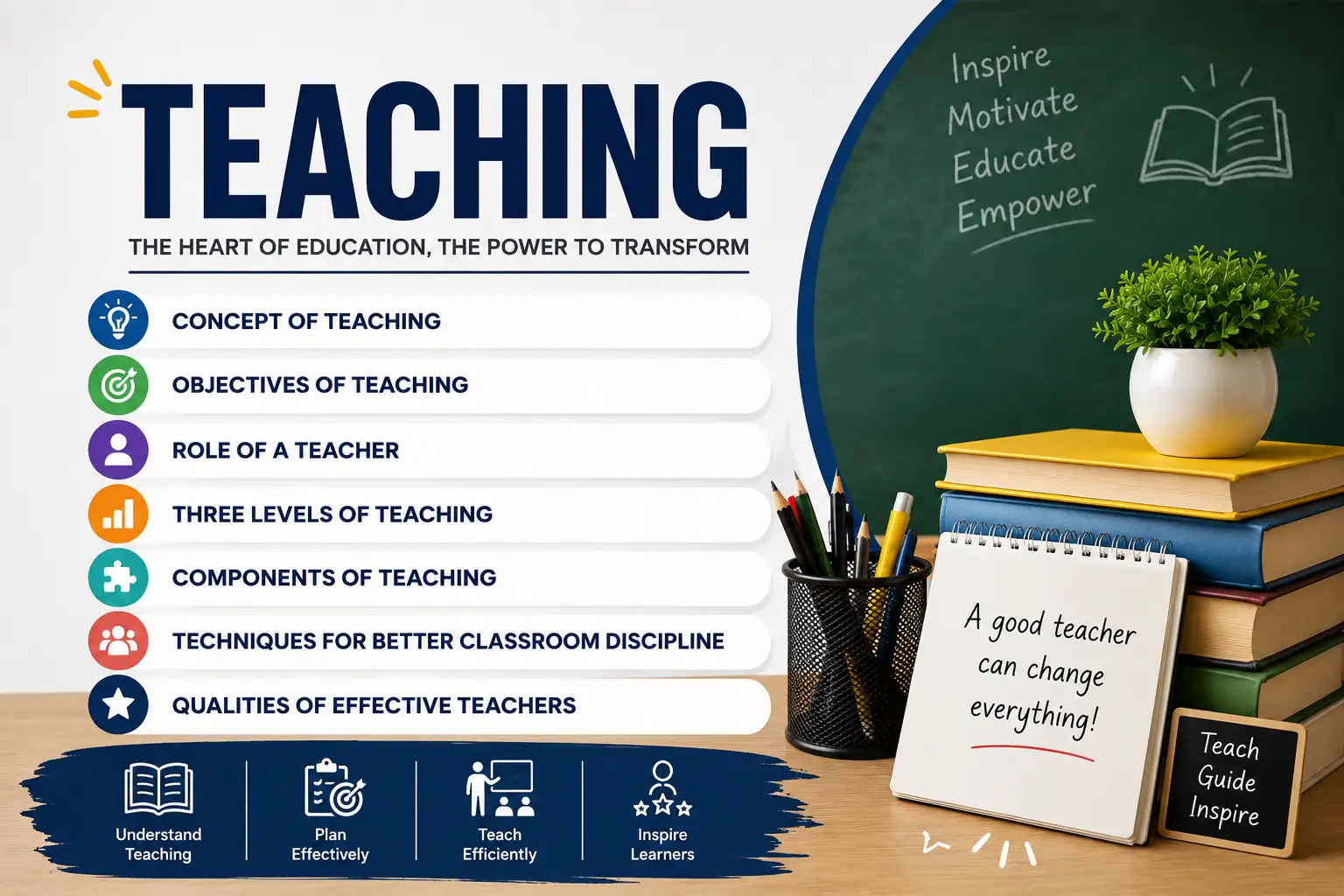
CONCEPT OF TEACHING
Teaching learning is a communication between two or more persons who influence each
other by their ideas and learn something in the process of interaction. It is a process in which
the learner, teacher, curriculum and other related variables are organized in a systematic
way to attain some predetermined goal. Teaching can be analysed in terms of teacher
behaviour at three levels, namely, component teaching skills, general teaching behaviours
and specific teaching behaviours.
OBJECTIVES OF TEACHING
- To develop all round personality of the learner through the curriculum.
- To shape the behaviour of the learner in a desired direction.
- To help the student to adjust and live harmoniously in the new situation environment.
- To encourage the student to learn and think for themselves to solve the problems.
- To acquaint the student with the content of the subject to be taught.
- The specific objectives of teaching are as follows:
- To Develop Critical and Logical Thinking
- To Create Interest in the Study
- To Develop Understanding
- To Develop of Knowledg
The specific objectives of teaching are as follows:
- To Develop Critical and Logical Thinking
- To Create Interest in the Study
- To Develop Understanding
- To Develop of Knowledg
ROLE OF A TEACHER
- Facilitating students in their efforts to learn without directly instructing them on any
- new concepts.
- Being sensitive to the previous experiences of each and every student in the class.
- Providing authentic (real-world and contextual) tasks.
- Providing as many materials and experiences from the immediate environment as
- possible. Manipulating materials and events so that the students can gather more
- experience.
- Providing real-world, context-based learning environments rather than predetermined
- instructional sequences for making learning more realistic, relevant and contextual.
- Focussing on realistic approaches to solve real-world problems.
- Providing or/and encouraging the students to come out with multiple representations or
- alternative solutions when engaged in solving a problem.
- Allowing students to ask questions and encouraging them to raise intelligent questions.
- Fostering reflective practice. By encouraging raising intelligent questions, indirectly put
- pressure to think reflectively.
- Supporting cooperative and collaborative learning in the classroom.
- Connecting the activities in the school with those outside the school.
- Encouraging self-analysis and self-assessment of students’ learning progress
THREE LEVELS OF TEACHING

TEACHING CAN BE DIRECT OR INDIRECT
- As the teachers use such methods as lecture, demonstration, etc and engages students
- in face – to – face interaction, they are teaching them directly.
- Conversely, when they use active methods like role-play, project, assignment, inquiry or
- other such activities, they are teaching them indirectly.
TEACHING CAN BE VERTICAL OR HORIZONTAL
- Depending on the objectives of teaching, teachers may lead students deep into the
- topic.
- This type of teaching is known as vertical teaching.
- Conversely, if the teachers teach one topic and then move on to more and more topics,
- they are resorting to horizontal teaching.
TEACHING MAY BE PLANNED OR UNPLANNED
- Traditionally, teachers plan for instruction before they go to the classroom for teaching.
- However, with the coming of active leaning methods, no strict planning is possible as one
- is not clear in advance what could be the possible way of organizing teaching learning
- activities.
COMPONENTS OF TEACHING

TECHNIQUES FOR BETTER CLASSROOM DISCIPLINE
- Focusing
- Direct Instruction
- Monitoring
- Modelling
- Non-Verbal Cuing
- Environmental Control
- Low-Profile Intervention
- Assertive Discipline
- Consistently
- Rule avoidance
QUALITIES OF EFFECTIVE TEACHERS
- Role of Caring
- Listening
- Understanding
- Knowing Students
- Role of Fairness and Respect
- Social Interactions with Students
- Promotion of Enthusiasm and Motivation for Learning
| Buy UGC NET Paper 1 Notes + PYQs | Click Here |
| UGC Official Website | ugcnet.nta.nic.in |