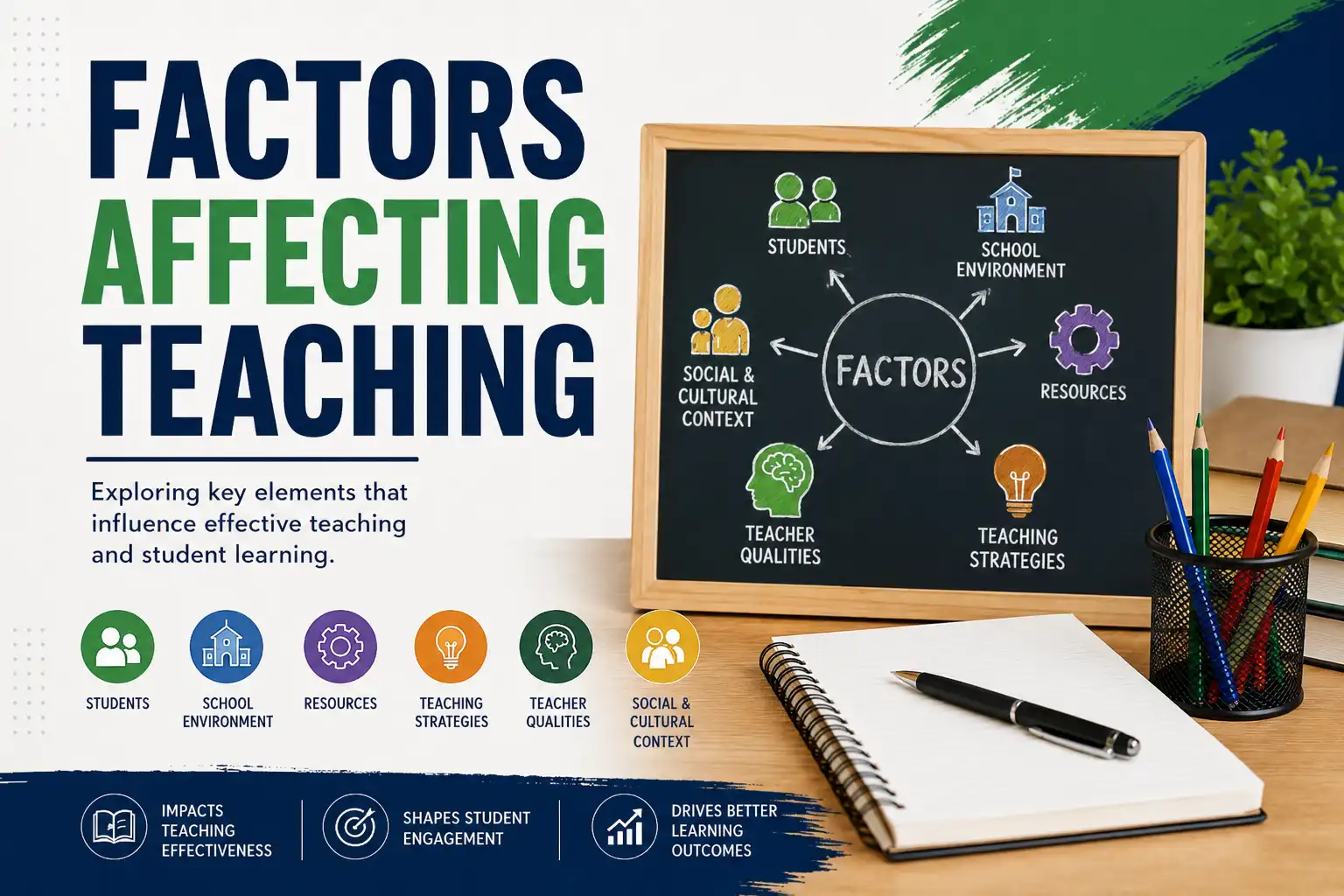
Factor Affecting Teaching are the elements that influence the effectiveness of the teaching-learning process. These factors include the teacher’s qualification, subject knowledge, teaching skills, personality, discipline, experience, and mental health. Learner-related factors such as physical and mental health, motivation, goals, readiness, and learning potential also play an important role. Support materials like books, videos, online tutorials, and teaching aids make learning more effective and engaging. A positive teacher-student relationship creates confidence, emotional growth, and better learning outcomes. Proper instructional facilities, healthy classroom environment, supportive administration, and flexible institutional policies further enhance the quality of teaching and ensure effective learning experiences for students.
FACTORS AFFECTING TEACHING
The various factors that come into play whenever a teaching learning process is underway
are related to the following:
- Teacher
- Learner
- Support material
- Teacher- student relationship
- Instructional facilities
- Teacher- administration relationship
- Learning environment/Classroom environment
- Institution and administrative policies

A) TEACHER
i. Educational Qualification and Subject Knowledge
ii. Awareness of learner factors
iii. Experience of the teacher
iv. Parental expectation
v. Teaching Skills
vi. Methods of teaching
vii. Friendliness and Approachability
viii. Personality and behaviour
ix. Level of Adjustment and Mental health of the teacher
x. Discipline
xi. Economic factor
B) LEARNER
i. Learner’s physical and mental health
ii. Learner’s basic potential
iii. The level of aspiration and motivation for achievement
iv. Goals in life
v. Readiness and will power
C) SUPPORT MATERIAL/LEARNING RESOURCES
Material is an umbrella term that includes audios, videos, online tutorials, open journals,
online tests and all kinds of teaching aids. The teacher alone cannot suffice for all
requirements of an effective teaching and learning process. Inclusion of support material
increases the effectiveness of the teaching- learning process and makes achievement of
learning outcomes easier.
D) TEACHER-STUDENT RELATIONSHIP
Teacher-student relationship is the cornerstone of a student’s social maturation process.
Cultivating a good rapport with a non-parental adult authority paves the way to selfdiscovery, adjusting in the social/cultural environment and developing their emotional
intelligence.
Positive relationships with teachers become game changers for kids. Even students with
learning and behavior disorders who may be initially stressed out settle down well,
physically as well as emotionally, and perform at their very best when the teacher by
connecting to them personally creates a positive, safe and structured environment to learn.
E) INSTRUCTIONAL FACILITIES
Instructional facilities include all that is required to create a learning environment.
Institutions of learning provide classrooms, laboratories, audio-visual presentation rooms,
seminar rooms, auditoriums, libraries and other spaces to be used primarily for the purpose
of delivering formal instruction to students. These facilities enhance the teaching-learning
experience and they must be available in adequate amount to cater to every single student
so that equality of opportunity is assured.
F) TEACHER-ADMINISTRATION
If the relationship between the teacher and the administration/ management of the school
is not cordial and professional, it may introduce several hindering factors into the teachinglearning process. It may weigh on the teacher’s state of mind which will invariably translate
to their body language and unsettle the learners too. To achieve the goals of education and
ensure an optimal functioning of the teaching-learning processes, it is essential that there isno adversarial relationship between teachers and administrators
G) LEARNING ENVIRONMENT/CLASSROOM ENVIRONMENT
Learning environment refers to the diverse situations, physical locations, contexts, and
cultures in which teaching learning processes are carried out. Apart from limited and
traditional classrooms with rows of desks and a chalkboard or smart board, learning can
happen in a wide variety of settings in off-campus outdoor locations. Learning environment
encompasses the culture, ethos and characteristics of a traditional school or class in the
manner the teacher and the taught interact with and treat one another as well as the ways
in which teachers may organize an educational setting to facilitate learning.
H) INSTITUTION AND ADMINISTRATIVE POLICIES
The infrastructure of the institution and the policies framed by their governing bodies, may
also affect teaching. If the school lacks required infrastructure or school policies control or
restrict the classroom activities, it will invariably constrain the teacher from proper
deliverance of the lessons. On the other hand, giving autonomy to the teacher and allowing
them the freedom and flexibility to choose teaching methods, classroom activities, etc., will
enhance teaching practices as well as learning experiences
1. What are the main Factor Affecting Teaching?
The main Factor Affecting Teaching include teacher qualities, learner characteristics, teaching methods, classroom environment, instructional facilities, support materials, and institutional policies.
2. Why is the teacher considered an important Factor Affecting Teaching?
A teacher’s subject knowledge, teaching skills, personality, discipline, and experience directly influence the effectiveness of the teaching-learning process and student performance.
3. How does the classroom environment affect teaching?
A positive classroom environment encourages interaction, motivation, discipline, and better understanding, making the teaching-learning process more effective.
4. What role do learning resources play in Factor Affecting Teaching?
Learning resources such as books, videos, smart classes, online tutorials, and teaching aids improve understanding and make lessons more engaging and interactive.